

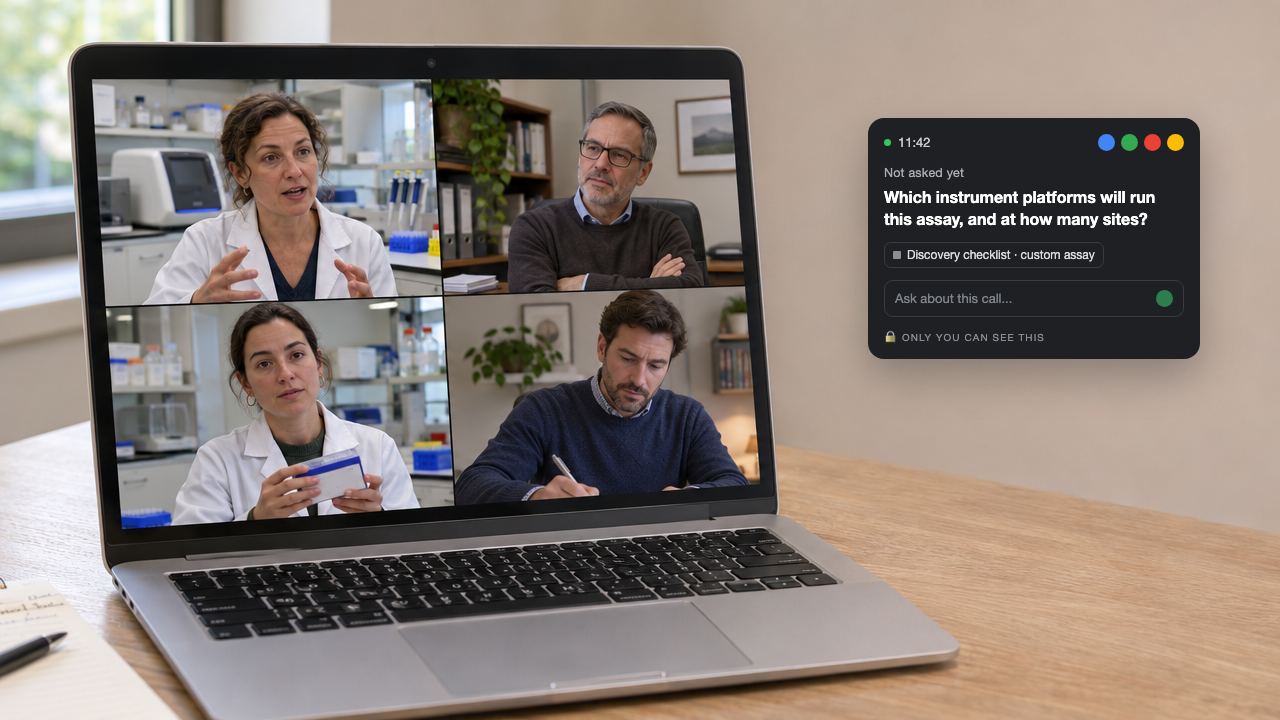
Biotech sales discovery is the set of questions a sales rep asks to learn what a customer truly needs before the work starts. In custom assay deals for molecular diagnostics, it decides the outcome. The spec sheet the customer sends lists targets and performance claims. The requirements that cause late failures, such as lot-to-lot consistency, instrument platforms, number of sites and validation plans, are usually not on it.
Key takeaways
- In custom assay deals, the spec sheet the customer sends is rarely the full requirement. Reproducibility, instruments, sites and validation plans usually sit behind it.
- Five discovery questions prevent most late surprises: real sensitivity need, number of sites, instrument platforms, acceptable lot-to-lot variation, and how the assay will be validated as part of an LDT.
- A missed requirement costs little to fix in discovery and a lot to fix after development starts.
- Requirements captured in the customer's own words help R&D, quality, manufacturing and regulatory teams decide earlier.
- AI helps most when it prompts the rep about questions still open during the call and turns the answers into a requirements list after it.
Why the spec sheet is not the requirement
Customers judge a molecular assay on analytical sensitivity, specificity, reproducibility, limit of detection and clinical validation. Those numbers are on the spec sheet.
What decides whether the customer stays happy is not. They expect the assay to work the same way every time:
- one lot performs like the last lot
- results on one instrument match results on another
- reagents bought months apart give the same outcome
Most of what can break those expectations is invisible to the customer. Raw material variation, manufacturing tolerances, reagent stability, operator differences and instrument behaviour all affect performance. Managing them is the supplier's job. But a supplier can only plan for expectations it knows about.
This matters most for Research Use Only (RUO) assays that customers build into laboratory developed tests (LDTs). The lab carries the validation. Every assumption the supplier makes about how the assay will be used becomes the lab's risk, and then the supplier's.
Discovery questions for custom assay deals
These five questions catch most of the gaps I see. Each one has a typical cost when nobody asks it.
1. What sensitivity do you actually need, and what drives that number? A limit of detection copied from a competitor's datasheet is different from one driven by a clinical decision. If you don't know which it is, you may over-engineer the assay or miss the point that matters.
2. Will the assay run at more than one site? One lab with one team is a different product from five sites with different operators. Multi-site use changes training, controls and how much variation is acceptable.
3. Which instrument platforms are already in use? An assay tuned on one platform can behave differently on another. The customer often assumes compatibility and never mentions it.
4. How much lot-to-lot variation is acceptable? Ask for a number, and ask what happened the last time a lot shifted. This one answer shapes quality control and manufacturing release criteria.
5. How will you validate the assay as part of your LDT? The validation plan tells you what data, documentation and consistency the customer needs from you, and when.
Then cover the rest: sample types and specimen handling, throughput, workflow integration, and how results are reported and interpreted.
What a missed requirement costs
A missed requirement is cheap in discovery and expensive later. Found on the first call, it is one more line in the scope. Found during development, it is a change in scope and a new timeline. Found after scale-up, it can mean an assay that meets the written request and still fails in the customer's lab.
The usual pattern is simple. The rep writes down the request, passes it to product development, and the project starts. Assumptions fill the gaps. Nobody notices until the customer's results don't match what they expected.
How AI helps biotech sales teams ask every question
Good reps know these questions. The problem is that a live call doesn't follow a checklist. The customer talks about targets for twenty minutes, the call runs out of time, and question four never gets asked.
This is where Sunnyside AI helps, in three places:
- Before the call, prep lists what is still open for this account, so the rep walks in knowing which requirements are missing.
- During the call, live assist shows a short prompt on the rep's own screen when a topic, such as instrument platforms or validation plans, hasn't come up yet. The customer sees nothing extra.
- After the call, the notes turn the conversation into a requirements list in the customer's own words, organized by topic.
The rep still leads the conversation and decides what to commit to. The AI makes sure the questions get asked and the answers don't get lost.
Why better discovery helps every team, not just sales
When requirements arrive complete and in the customer's words, every team downstream decides earlier:
| Team | What it can do earlier |
|---|---|
| Product management | Prioritize development work on what the customer will judge |
| R&D | Assess technical feasibility before committing |
| Quality | Set quality metrics that match the customer's expectations |
| Manufacturing | Find scale-up risks before they reach the customer |
| Regulatory | Plan for the customer's validation needs |
That is also what lets a company commit to a delivery date with confidence.
Custom assays are where discovery matters most
Many labs need things off-the-shelf products don't offer: custom target panels, special workflows, specific reporting or performance characteristics. These programs are often among the most valuable deals a molecular diagnostics company can win. They also carry the most technical and commercial risk.
In biotech sales, the number of calls matters less than what each call captures. A customer buying a custom assay is buying confidence that it will perform the same way, every time, in their lab. That confidence starts with asking the right questions before development begins.