

You hire ten new reps. Chirpy, sharp, communicate well, genuinely excited to start.
You build a solid two-week program — product, ICP, objection handling, all of it. They ace the knowledge tests. They do well in mock calls, one or two each, in front of the whole team. You shadow them with your top performers. They get their certificates. You feel good about this batch.
Then Day One happens.
Zero meetings booked. A rep freezes because the customer said something that wasn't in the training deck. Objections go nowhere. One prospect says, "Don't call me again." By end of day, the same reps who aced their certification are visibly rattled.
A few months later, scenario two. Your seasoned team's numbers have dipped. You bring in a well-regarded trainer for three days — good frameworks, good facilitator, the whole thing. The team loves it. Great food, an evening out, a real break from the grind. Everyone comes back energized.
A month later? Nothing's moved. If anything, it's worse. You got the best person in the field to run this. And nothing changed.
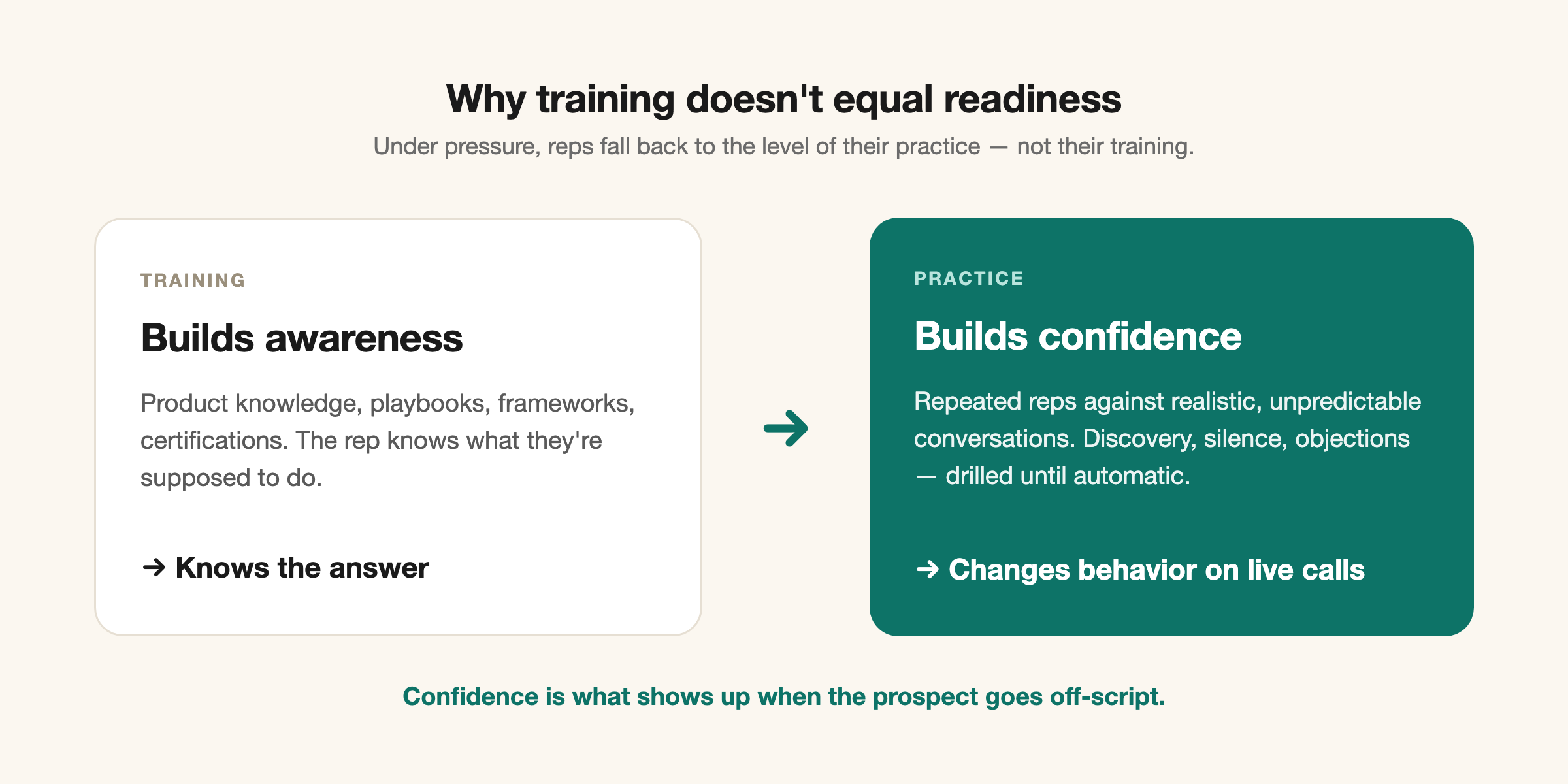
Here's what both of these actually are: the same mistake, twice. You gave your team training. You never gave them practice. And those are not the same thing.
Why Training Doesn't Equal Readiness
Your reps learned something in that room. The question that actually matters is — where did they rehearse it?
This isn't about motivation, and it's not a hiring miss. It's memory, and it's been studied for over 140 years. Psychologist Hermann Ebbinghaus ran the original experiments on himself back in the 1880s, and the pattern he found — now called the forgetting curve — has held up in study after study since: we lose new information fast, and we lose most of it early, unless something forces us to use it again.
The sales-specific numbers are worse, not better. ATD's 2023 State of Sales Training report, citing Gartner research, found B2B reps forget about 70% of training content within a week, and 87% within a month. A handful of other industry studies land in the same neighborhood — 84% of sales training forgotten within 90 days is a commonly cited figure, and one analysis put it at half of everything learned, gone within five weeks.
Different sources, same story: whatever your reps demonstrated on the last day of training is mostly gone a week later — unless something made them use it again in between.
That's exactly what happened with your seasoned team. Three excellent days. Zero built-in reason to revisit any of it afterward. The trainer didn't fail. The format did — one event, no system to keep the content alive once everyone went back to their desks.
The "Just Let Them Practice on Real Calls" Trap
The obvious next move feels like: fine, they need more reps at it — let them get reps in on actual calls. That's the mistake in scenario one, and it's the expensive kind.
A live prospect call isn't a practice space. There's no pause button. No do-over. No one whispering a better opening line in the rep's ear. When your Day One hire freezes because the objection wasn't in the script, that's not a confidence issue — that's what happens, every time, when someone performs a skill for the first time in front of the exact person whose trust they're trying to earn. Every fumbled call costs you a burned prospect and a dent in your brand that never shows up on a spreadsheet.
The ramp-time numbers back this up. New reps typically take somewhere between three and six months to hit full quota, depending on role and deal complexity — and that number has been getting longer over the past few years, not shorter. Some analyses of SaaS sales orgs found that shaving even 10% off ramp time can add millions in annual recurring revenue for a mid-sized company. Every extra week a rep spends "figuring it out live" is a week you're paying full salary for underperformance.
Training Gives Knowledge. Practice Builds Reflexes.
Here's the piece both scenarios miss: training hands over information. Readiness is a different thing entirely — it's reflex.
The research on skill-building — a lot of it tied to Anders Ericsson's work on deliberate practice — says the same thing across every field, from music to surgery to flying planes: expertise doesn't come from being told something. It comes from doing it, wrong and then right, over and over, with feedback, in conditions that actually look like the real thing. No surgeon operates on a real patient the first time. No pilot flies a commercial route before hundreds of hours in a simulator.
Yet we routinely send new reps into live, revenue-bearing conversations off the back of one mock call, watched once, by their peers, in a room that looks nothing like a real sales conversation.
That one mock call isn't practice. It's a snapshot. It tells you whether someone can perform once, under artificial, low-stakes conditions. It tells you nothing about whether they can recover when a real customer pushes back in a way nobody scripted for.
The reps who don't freeze on Day One aren't smarter. They've just already handled that exact objection — or something close to it — enough times that the response comes without having to think.
Closing the Gap: What Actually Needs to Change
None of this means your training was wasted. Your two-week program and your three-day refresher both did real work — reps need frameworks and language to start from. The problem isn't the content. It's stopping there.
A few things that actually move the needle:
Reinforce early, not eventually. Forgetting is steepest in the first few days. A single follow-up weeks later is too late — short, spaced touchpoints in the first two weeks do more for retention than one big session ever will.
Keep practice and performance separate. Reps need somewhere to fail — repeatedly, safely, cheaply — before a customer ever hears their voice. That space has to feel like a real call, not a script read out loud in a conference room.
Get the reps count up. One or two mock calls isn't practice, it's a demo. Real reflexes for objection handling come from dozens of varied reps, not a couple of showcase moments.
Measure readiness, not attendance. A certificate says someone sat through a training. It says nothing about whether they can hold their ground on a live objection. Only one of those predicts what happens on Day One.
This is the layer most sales orgs are missing — not because leaders don't know practice matters, but because giving every rep enough realistic, varied, feedback-rich practice has always needed more manager hours than anyone actually has. That's the exact gap AI-powered practice tools like Sunnyside are built to close — unlimited reps, realistic pushback, consistent feedback — so the first time your rep handles a curveball objection isn't in front of a paying customer.
The forgetting curve isn't going anywhere. But the gap between what your team learns and what they can actually do on a live call? That one's closeable — the day you stop treating training as the finish line and start treating practice as the actual job.
FAQ
What's the difference between sales training and sales readiness?
Training transfers knowledge — frameworks, product info, scripts. Readiness is whether a rep can apply that knowledge live, under pressure, when a customer says something unscripted. You can have one without the other.
How much sales training do reps actually retain?
Industry research citing Gartner data puts it at roughly 70% forgotten within a week and 87% within a month, without reinforcement. Other studies land in a similar range — most training is largely gone within 90 days if it isn't actively practiced.
Why doesn't refresher training fix a performance slump?
Because a single event, however well delivered, has no built-in mechanism to keep the material alive afterward. Without spaced reinforcement and hands-on practice, the same forgetting curve applies to refresher training as to initial onboarding.
Close the readiness gap before Day One
Book a 30-minute demo. We'll run a live AI roleplay with one of your real scenarios and show you how reps get unlimited, realistic, feedback-rich practice — so the first curveball objection they handle isn't in front of a paying customer.