

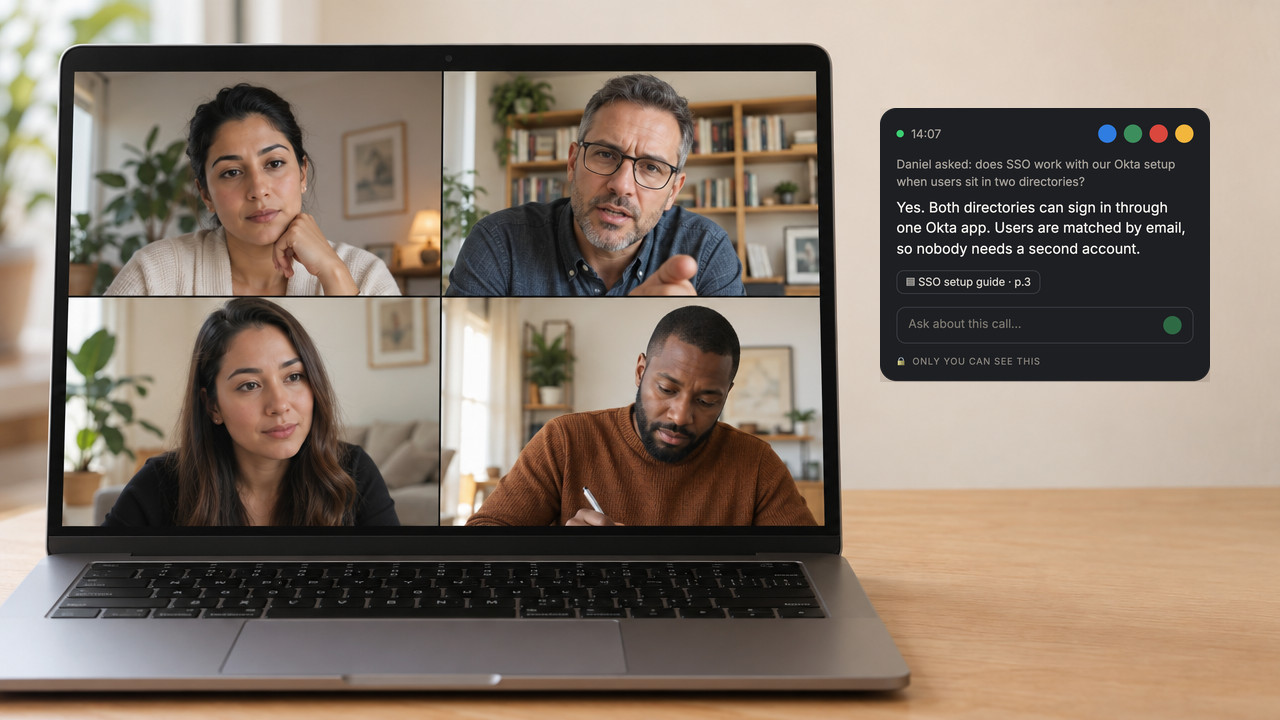
An AI copilot for sales engineers listens to a live customer call and shows answers from your own docs, battlecards and past calls in the moment. No one person can hold every product detail, integration and competitor update in their head, so the copilot keeps the SE, or the AE without one, accurate while the conversation keeps moving.
Key takeaways
- Four moments break technical calls: the surprise question, the competitor comparison, the integration query and the knowledge gap.
- AEs and generalist salespeople meet the same four moments, usually with no expert on the call.
- One unanswered question rarely kills a deal. Repeated uncertainty slows it, and buyers start to doubt the person, not only the product.
- An AI copilot helps most when it answers from your company's own material, names the source and stays quiet when it doesn't know.
- The person on the call still owns judgement: what to promise, what to scope, and when to say "I'll confirm."
The demo is going well. Then the security architect, quiet for twenty minutes, unmutes.
"How does your SSO work with our Okta setup when users sit in two directories?"
The SE knows SSO. She's not sure about the two-directory part. Product shipped a change last quarter, and she skimmed the release note between two other calls. Four faces are on the screen. The architect has his pen out. She has about three seconds to decide: answer from memory, or say, "Let me confirm and get back to you."
Both choices cost something. A guess that turns out wrong becomes the line the architect repeats in his internal review. A "let me confirm" is fine once. It's the third one in a call that buyers remember.
Every SE has lived that moment. The question is what should be sitting next to them when it happens.
Why do technical calls break more often now?
Because the job got wider than one head. Products ship every month, integrations multiply and competitors rewrite their pitch every quarter. SEs are experts, but they're experts in a moving target.
There's less time to keep up, too. Salesforce's 2026 State of Sales announcement puts the average seller's selling time at 40% of their week. The release notes, the new battlecard and the updated security answers all compete for what's left.
The buyer side raises the stakes. Gartner reports that 75% of B2B buyers prefer a rep-free experience. They read your docs, your reviews and your competitor's comparison page before they ever book a call. When buyers are less familiar with a product, Gartner found they want a human mainly to ask questions and understand use cases. So the few calls you do get are dense with technical questions, asked by people who already know the easy answers.
I spent roughly seven years in sales at LinkedIn, and before that worked at HBO and Viacom18. The calls I remember most aren't the ones where I pitched well. They're the ones where a single technical question changed the temperature in the room.
The four moments that break a technical sales call
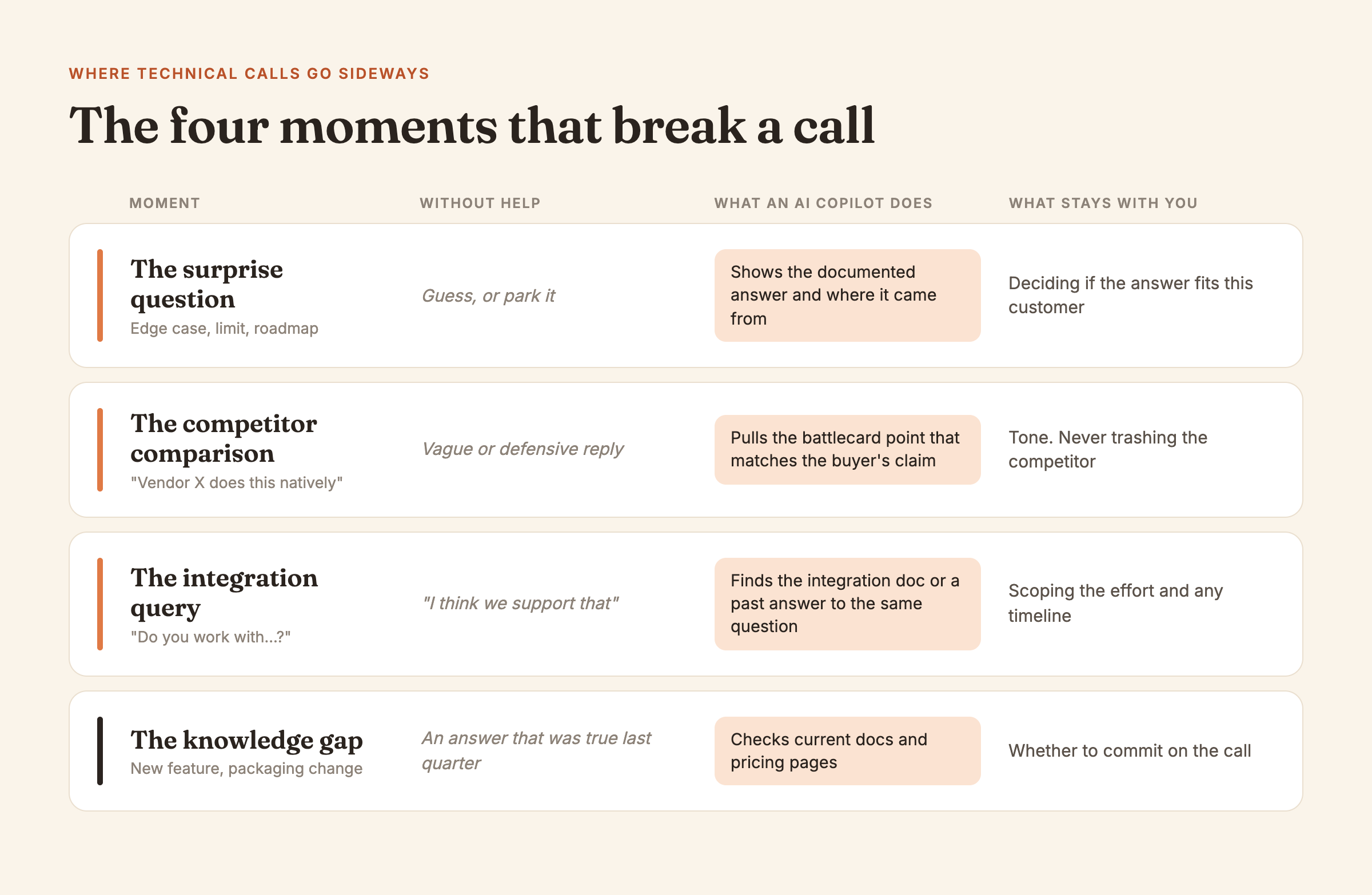
After years of those calls, and many more conversations with SEs while building Sunnyside, I see the same four moments again and again. Each one has a bad default, a place where help is useful, and a part that should stay with the person on the call.
Moment 1: The surprise question
This is the Okta moment. An edge case, a limit, a "what happens when". "What's the maximum file size for the bulk import?" "Is data residency in the EU on the roadmap?" The question is narrow, specific and nowhere in the demo script.
The bad default is a guess said with confidence, or a park that sounds like a dodge. What the rep should do instead is answer the documented part, say where it comes from, then check fit with a question back: "Our SSO docs say we support multiple directories through separate connections. Is the second directory from an acquisition, or a separate user group?" The fact comes from the docs. The follow-up question is the SE doing the job only a person can do.
Moment 2: The competitor comparison
The competitor moment is the one I see handled worst. The buyer says, "Vendor X told us they do this natively."
A rushed SE either argues or goes quiet. Arguing makes the buyer defend the other vendor. Going quiet makes the claim true by default.
A better answer sounds like this: "They do have a version of that. Here's how ours differs for a setup like yours, and here's a customer who switched for that reason." That answer has three parts: acknowledge, differ, prove. It needs facts at hand, not a memory of a battlecard from onboarding. The tone, and the discipline to never trash the competitor, stays with the person speaking.
Moment 3: The integration query
"Does it push tickets into our ServiceNow, or do we build that?" "Can we pull call data into our warehouse?"
The danger phrase here is "I think we support that." It feels helpful in the moment. It turns into a problem three weeks later, when the buyer's engineer tries it and finds out "support" meant a community connector nobody maintains.
The rep's move is to find the integration doc, or the answer someone gave to the same question on a past call, and say exactly what exists today. Then scope it out loud: "That part is out of the box. The custom field mapping is a short piece of setup work, and I'd like our SE to walk your team through it." Effort and timeline are commitments. They stay with the person who will have to keep them.
Moment 4: The knowledge gap
This one is quiet, which makes it dangerous. The rep gives a clean, confident answer that was true last quarter. Audit logs used to be an Enterprise feature. Last month packaging changed. Nobody on the call notices, until the order form doesn't match what was said.
The fix isn't more memorising. It's checking the current docs and pricing pages at the moment the question lands, then deciding whether to commit on the call or confirm in writing. A rep who says "As of this month, that's included in the plan you're looking at" sounds more credible than one who answers from memory, because they are.
Who faces these moments when no expert is on the call?
Most of the time, it isn't an SE. It's the AE, the account manager or the founder doing sales, alone.
In Salesforce's State of Sales research, 81% of reps said team selling helps them close. But no company can put an SE on every first call. So the same four moments arrive on calls where the person answering has a sales background, not a technical one.
That's where "let me get back to you" piles up. Say it once and nobody minds. Say it several times in one call and the customer starts wondering, quietly: does this person really understand the product?
In B2B sales, the customer isn't only evaluating your product. They're deciding whether they can trust you. One unanswered question doesn't kill a deal. But repeated uncertainty slows it, and slow deals lose momentum.
I want to be clear about one thing. A salesperson who can't answer every technical question isn't a bad salesperson. The job changed around them. Products change constantly, buyers know more, and there's less time to learn. This is a support problem, not a skill problem.
And confidence follows support. When the facts are within reach, a rep stops bracing for the hard question and starts inviting it. With a copilot, an AE can handle first-level technical questions on their own: "Yes, we support SCIM provisioning with Okta. I'll have our SE walk your team through the two-directory setup on Thursday." The SE's time goes to the calls that need deep work, not the ones that needed one fact.
If you're working out how far your SE team can stretch, I wrote separately about SE coverage and which questions AI can safely take. This post is about what happens inside the call.
What should an AI copilot for sales engineers do?
An AI copilot for sales engineers is software that listens to a live customer call and shows the SE relevant, sourced answers on their own screen while the conversation is happening.
A useful one does five things:
- Answers from your material first. Product docs, security answers, battlecards, past calls with this buyer.
- Names the source on every answer, so the SE can judge it in a glance.
- Stays quiet when it doesn't know. A confident wrong answer on a security call is worse than silence.
- Stays off the buyer's screen. No bot joining the meeting.
- Flags what's still open before the call ends, so nothing slips into the follow-up.
Map those back to the four moments. The surprise question needs the source. The competitor comparison needs your battlecard, not the internet's opinion. The integration query needs past answers to the same question. The knowledge gap needs current docs, not last quarter's.
What should stay with the person on the call?
Discovery, architecture judgement and scoping stay human. So does saying no.
If the answer involves a custom build, a timeline or a contract term, the copilot can show you the facts. The commitment is yours. Reading the room, knowing when to push and when to pause, being honest when you're unsure: that's still the job.
And a copilot shouldn't put words in your mouth. An SE who reads a card out word for word stops listening, and buyers notice. The point is to stay in the conversation, with the facts within reach.
Where Sunnyside fits
We built Sunnyside for exactly these moments. It runs on your computer and never joins the meeting. During the call it answers from your product docs, pricing and packaging, battlecards, security and compliance answers, case studies, earlier calls with the buyer and Slack, and each card names its source. If it doesn't know, it stays quiet.
Five minutes before the end, it shows what's still uncovered, what went unanswered and what you promised. It works on Zoom, Google Meet, Microsoft Teams and Slack huddles. Before the call, it preps you. After, it writes the notes and the follow-up. If your team sells into security-heavy buyers, see how this plays out in cybersecurity sales.
Sergio Llopis, VP of Sales and Marketing at Coderland, put it simply: "My sales reps are more prepared and confident when handling technical questions."
That confidence is the point. You can try it on your next call and see which questions stop being "let me get back to you."
Next in the technical sales series: What Is a Real-Time Sales Assistant?.
Frequently asked questions
What is an AI copilot for sales engineers?
An AI copilot for sales engineers is software that listens to a live customer call and shows relevant answers on the SE's own screen. Good ones answer from company material such as product docs, security answers and battlecards, name the source of each answer, and stay silent when they don't have a reliable answer.
Will an AI copilot replace sales engineers?
No. A copilot handles recall: finding the right fact quickly. Sales engineers handle judgement, such as discovery, solution design, scoping and deciding what to commit to. The practical effect is that SEs spend less time on one-fact questions and more time on the calls that need real technical depth.
Can an AI assistant help non-technical salespeople sell technical products?
Yes, within limits. An AI assistant can show accurate, sourced answers from company material during the call, which helps a non-technical rep handle first-level technical questions confidently. Complex architecture, custom scoping and contract commitments should still involve a sales engineer or technical expert.
Can the customer see the AI during the call?
It depends on the tool. Some assistants join the meeting as a visible bot. Others, like Sunnyside, run on the rep's own computer, listen to the call audio and show answers only on the rep's screen, so the buyer sees nothing extra in the meeting.
Where does an AI sales copilot get its answers?
The best answers come from your own company knowledge: product documentation, pricing and packaging, competitor battlecards, security and compliance answers, case studies and past calls with the same buyer. Some tools also search the web, which is useful only when the result is cited so the rep can check it.
How is a sales copilot different from a call recorder?
A call recorder captures the conversation for review afterwards. A sales copilot helps during the conversation, while the buyer is still waiting for an answer. Many teams use both: a copilot to get the answer right live, and recordings or analytics to review patterns later.