

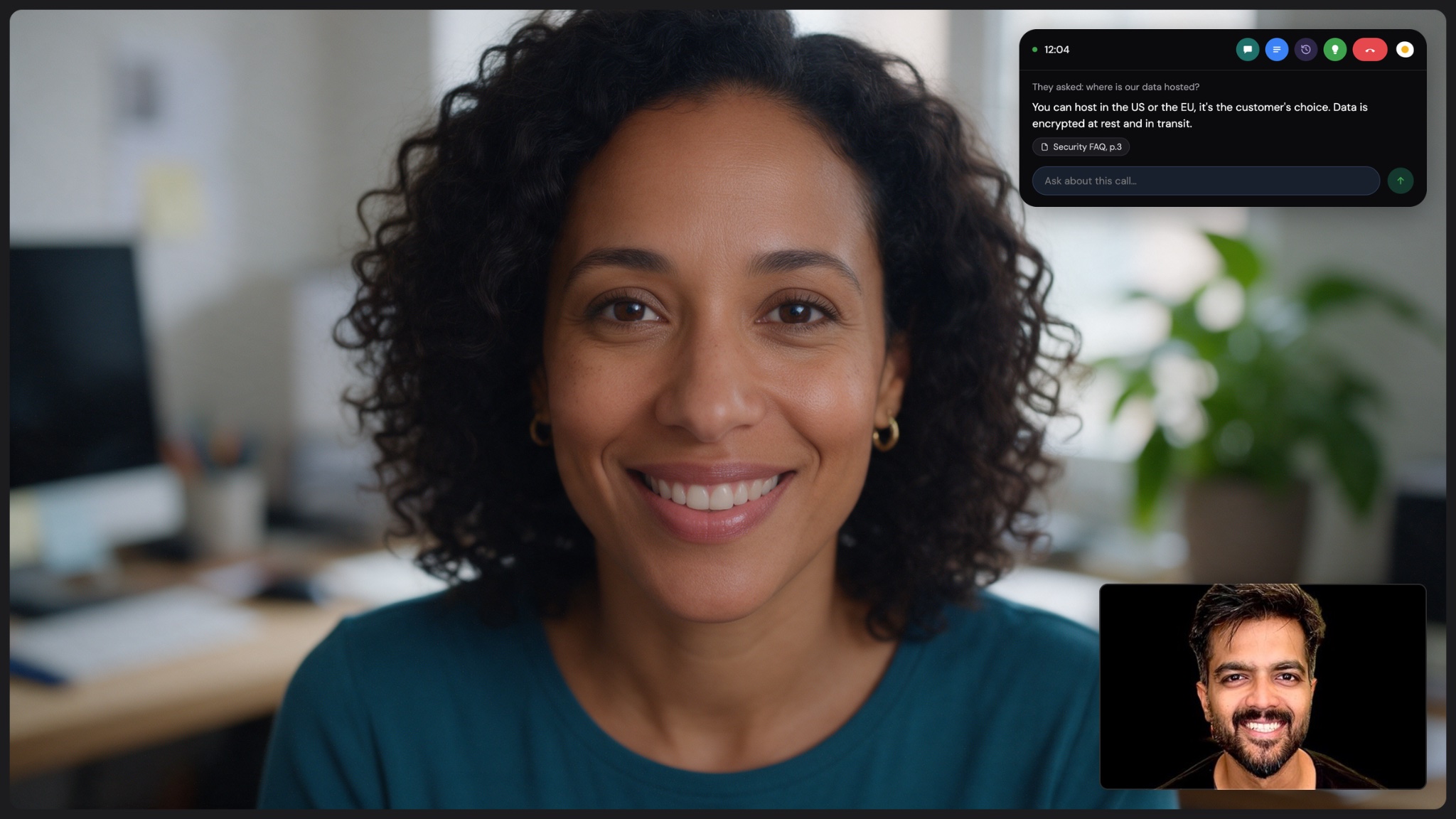
An AI sales engineer can be a desktop app like Sunnyside AI Live assistant that listens to a live sales call, recognises technical questions, and shows the rep a short answer from the company's own documents and past calls. It covers repeat, documented questions about security, integrations and the product. It does not replace human Sales Engineers for architecture, proofs of concept or exceptions.
The relief of having someone beside you
During my roughly seven years at LinkedIn, I was lucky to work with two great Client Solutions Managers, Mani and Sharadha. Whenever one of them joined my customer call, I remember feeling real relief. I knew: I've got this. I'm covered. If the customer asked something technical I wasn't sure about, I had someone beside me who could handle it.
But they couldn't be on every call. And on the calls without them, I wasn't always as confident.
I don't think that makes a salesperson bad at the job. Products change every quarter. Customers come in better informed. There's more admin, more pressure to do more with less, and very little time left to stay current.
I used to think, "I wish I had a friend sitting beside me on every call. Someone who could help me without judging me." That's the honest reason the idea of an AI sales engineer matters to me.
Why your SE can't be on every call
It's a numbers problem. Consensus's Sales Engineering Workload report put the average ratio at about four AEs for every SE. Every technical question in every one of those AEs' deals ends up in a queue behind one calendar.
So on a first call, when a buyer asks where their data will be stored, the AE has two bad options. Say "let me bring in our SE" and wait a week for a slot. Or guess, and hope security review doesn't catch the mistake later. We looked at that exact moment in when IT and Finance join the call.
Meanwhile the SE spends a big part of the week answering the same questions they answered last week. Which CRMs do you integrate with. Do you support SSO. Is there an API. The work only they can do gets pushed to the evenings.
This isn't an argument for fewer SEs. Alexander Group's benchmark found sales teams with one SE per rep averaged higher revenue per rep than teams with one SE for five reps. SEs are worth a lot. That's exactly why their time shouldn't go to repeat questions.
What is an AI sales engineer?
An AI sales engineer is software that listens to a live sales call, recognises a technical question, and shows the rep a short answer from the company's own material, with the source attached.
The important word is live. Most companies already have a knowledge base. Nobody searches it while a buyer is waiting for an answer.
It also helps to be clear about what it isn't.
| Option | Good at | Where it falls short on a live call |
|---|---|---|
| Knowledge base or wiki | Holding the answers | The rep can't search it mid-sentence |
| Generic AI chatbot | Fluent general answers | Doesn't know your product's approved answers, and can make things up |
| Human Sales Engineer | Judgement, design, trust with the buyer's engineers | Can't be on every call |
| AI sales engineer | Your documented answer, on screen, in seconds | No judgement on custom situations, no relationship |
The traffic-light test: which questions can AI answer?
I sort technical questions into three colours.
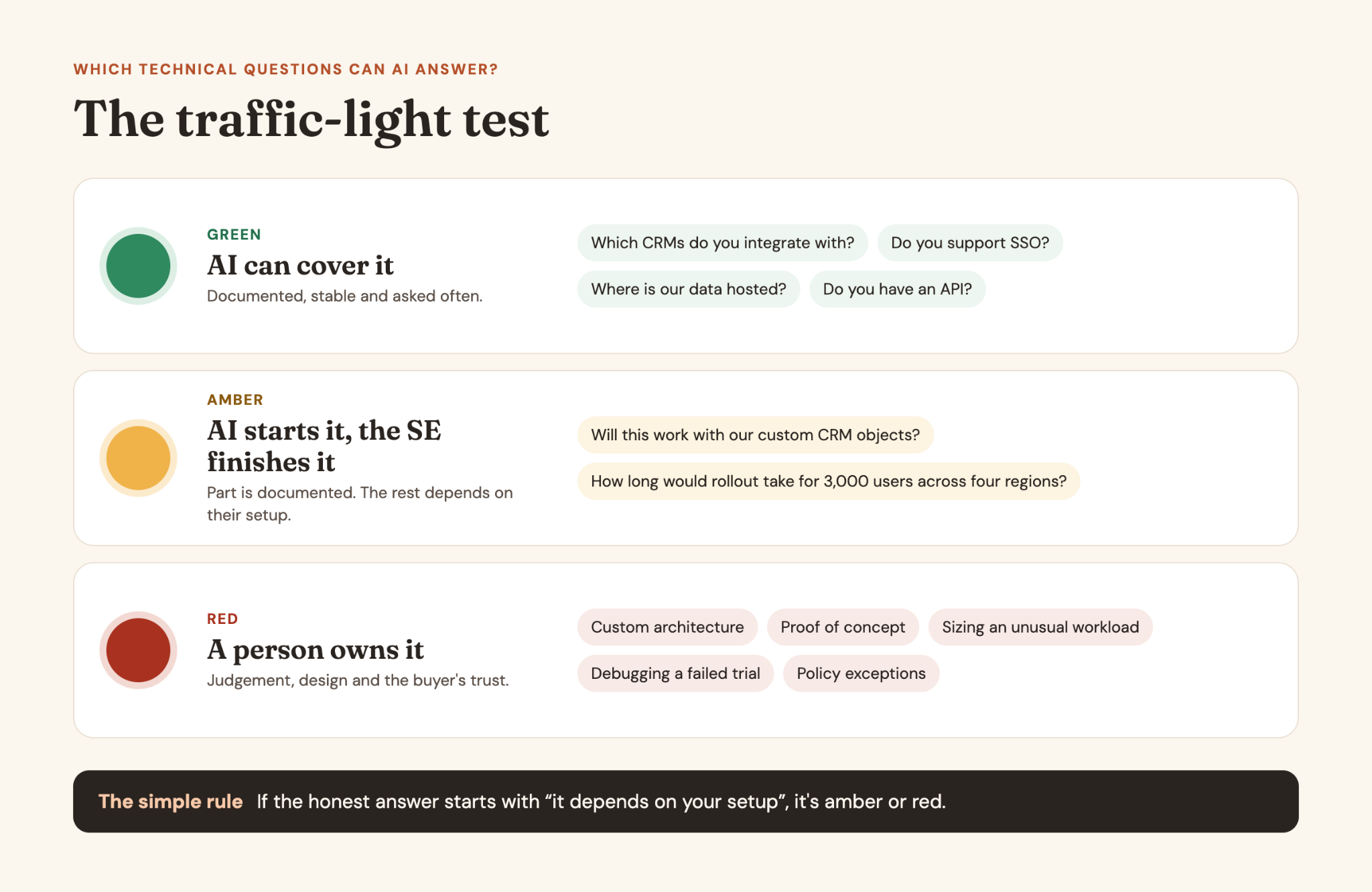
Green: AI can cover it. The answer is documented, stable and asked often.
- "Which CRMs do you integrate with?"
- "Do you support SSO?"
- "Where is our data hosted?"
- "Do you have an API?"
The rep reads the sourced answer, says it in their own words, and the call keeps moving.
Amber: AI starts it, the SE finishes it. Part of the answer is documented, but the full answer depends on this buyer's setup.
- "Will this work with our custom Salesforce objects?"
- "How long would rollout take for 3,000 users across four regions?"
The rep shares the documented part and promises the rest: "We sync standard objects out of the box. For your custom ones, I'll have our SE confirm by Thursday."
Red: a person owns it. Custom architecture. A proof of concept. Performance sizing for an unusual workload. Debugging a failed trial. Any exception to policy. And earning the trust of a sceptical architect, which only a person who has built things can do.
The simple rule: if the honest answer starts with "it depends on your setup", it's amber or red.
How the AE and SE work together when AI is on the call
The AI doesn't change who does what. It changes when the SE needs to show up.
For the AE: handle green questions on the spot. For amber and red ones, don't just forward a vague "customer has technical questions" message. Send the SE a proper handover:
- The question, in the buyer's own words
- Who asked it, and their role in the decision
- What you already told them
- The date you promised an answer
A good handover saves the SE from re-running discovery. It also stops the buyer hearing two different answers.
For the SE: the AI is only as good as what's written down. Every answer you write once, clearly, is an answer you won't have to give live on the next ten calls. Treat the answer bank as part of your job, and your calendar starts to open up for the work that needs you.
What an AI sales engineer should never do
It should never make up an answer. A confident wrong answer about security or data handling is worse than a delay, because it surfaces in review and makes the buyer doubt everything else you said.
It should never make commitments. Discounts, contract terms and roadmap dates need a human with authority.
And it shouldn't pretend to be the relationship. Buyers' technical teams trust people. Your SE is still the person they'll call when something breaks.
Where Sunnyside fits
This is the problem we built Sunnyside around.
Sunnyside's live assist runs on the rep's computer and never joins the meeting as a bot. When a buyer asks a technical question, it shows an answer from your own material: product docs, security and compliance answers, battlecards, pages from your website, past calls and what your team has said in Slack. Each card names its source. If it doesn't know, it stays quiet rather than guessing. After the call, the notes list what was asked and what you promised, with owners and dates, which makes the handover to your SE much easier.
The goal isn't to replace the Mani and Sharadha on your team. It's to give every rep a little of that "I'm covered" feeling on the calls where the SE can't be there. If that sounds useful, see how Sunnyside compares with other AI sales tools, or try it on your next call.
If you are choosing between practice tools and live help, our piece on AI roleplay vs live sales coaching explains how to decide.
Frequently asked questions
What is an AI sales engineer?
An AI sales engineer is software that listens to a live sales call, recognises technical questions, and shows the rep a short answer from the company's own documents, website and past calls, usually with the source attached. It helps account executives answer repeat technical questions on the spot, without waiting for a human Sales Engineer to join.
Will AI replace sales engineers?
No. AI can cover documented, repeat questions about integrations, security and product features. It can't design a custom architecture, run a proof of concept, size performance for an unusual workload or build trust with a buyer's engineering team. Those need a human Sales Engineer. AI frees up SE time for that work.
What does a sales engineer do on a sales call?
A Sales Engineer, also called a Solutions Engineer or presales consultant, handles the technical side of a deal. They run tailored demos, answer detailed product, security and integration questions, design how the product fits the buyer's systems, and run proofs of concept. They work alongside the account executive, who owns the relationship and the commercial side.
When should an AE bring a sales engineer into a deal?
Bring in a Sales Engineer when the answer depends on the buyer's specific setup: custom integrations, architecture, performance at scale, a proof of concept or a technical evaluation by the buyer's engineers. For documented questions such as supported integrations or SSO, the AE should answer directly, so the SE's time goes where it matters most.
What technical questions can AI answer on a sales call?
AI can answer questions that have a documented, stable answer: which integrations exist, whether SSO is supported, where data is hosted, whether there is an API, and similar product facts. It should not answer questions that depend on the buyer's specific setup or that create commitments, such as contract terms, discounts or roadmap dates.
What is a typical AE to SE ratio?
Ratios vary by product complexity and deal size. Consensus's Sales Engineering Workload research reported an average of about four account executives for every Sales Engineer. Companies selling complex, high-value products often run closer to one SE per AE, while transactional sales teams usually run higher ratios.
How is an AI sales engineer different from ChatGPT?
A general chatbot answers from general knowledge and can produce confident answers that are wrong for your product. An AI sales engineer answers from your company's own approved material, such as product docs, security answers and past calls, shows where each answer came from, and works during the live call without the rep having to type.