

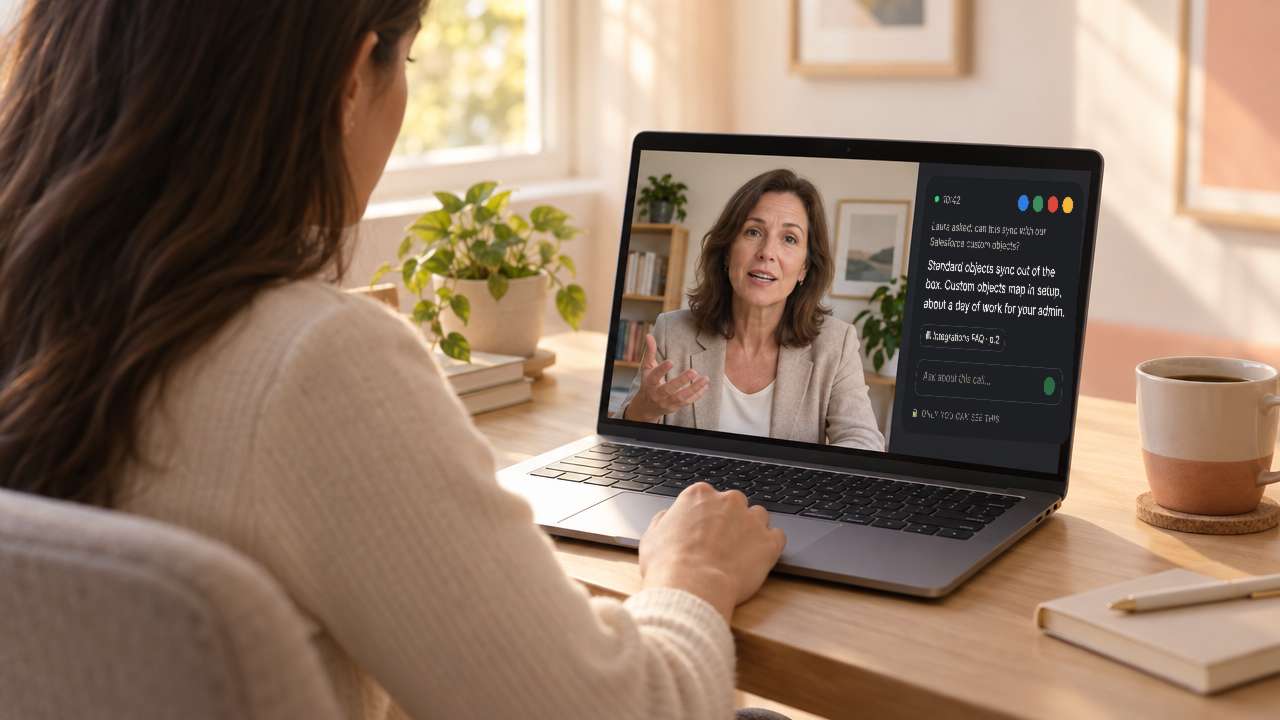
A real-time sales assistant is AI software that listens to a live sales call and shows the rep useful information while the conversation is happening: answers to buyer questions, help with objections and competitor mentions, and reminders of what's still open. Call recorders and post-call analytics help after the call. A real-time assistant helps during it.
Key takeaways
- Real-time assistance happens during the call. Recording and analytics happen after.
- It works by transcribing the call live, matching the moment to your company knowledge, and showing short cards on the rep's screen.
- One test matters most: can the rep use the suggestion before the moment passes?
- It's strongest on technical, pricing and competitor questions.
- It doesn't replace preparation, coaching or a good sales engineer.
The buyer asks, “Does this work if finance is on NetSuite and operations is on SAP?”
The rep isn't sure. A call recorder will capture the pause perfectly. Next Tuesday, a manager might even flag it in a review. Useful, but the buyer hung up a week ago.
What is a real-time sales assistant?
A real-time sales assistant is software that supports a salesperson during a live customer conversation, not before or after it. You'll also see it called a live call assistant, an AI sales copilot or in-call assist. Its close cousin is real-time sales coaching.
This is a newer category. Salesforce's 2026 State of Sales announcement found 87% of sales organisations already use some form of AI, mostly for prospecting, forecasting, lead scoring and drafting emails. Most of that AI works around the call. Very little of it works inside the call, which is where deals are actually won or stalled.
How does a real-time sales assistant work?
- Listens. It captures the call audio. Some tools join the meeting as a bot. Others run on the rep's computer.
- Transcribes. It turns speech into text as people talk.
- Spots the moment. A question, an objection, a competitor's name, a pricing ask.
- Finds the answer. It searches your product docs, battlecards, past calls and other approved material.
- Shows a short card on the rep's screen, ideally with the source named.
- Tracks what's open. Unanswered questions, promises made, agenda items not yet covered.
Real-time assistance vs call recording vs post-call analytics
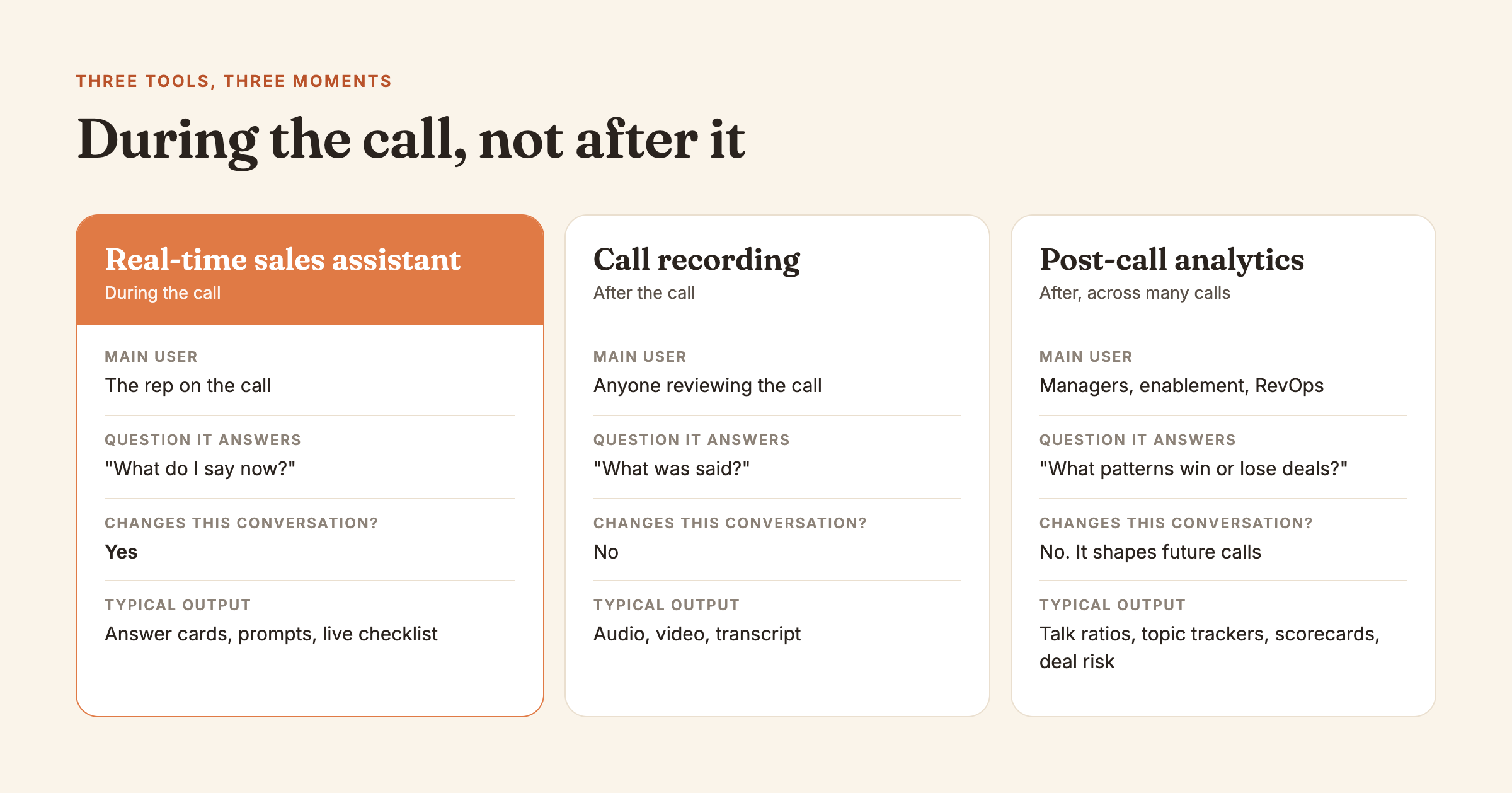
These aren't rivals. But if you buy analytics expecting live help, you'll be disappointed, and the reverse is also true. For a side-by-side of the three software categories, see our buying guide comparison.
The ten-second test
Here's the test I use for any live suggestion. Could the rep say it out loud within ten seconds, without breaking eye contact for long?
If not, it's noise. A paragraph of text on a second screen during a pricing question doesn't help. It distracts.
The test shapes what to look for in a tool:
- Short cards, one idea each.
- A visible source, so the rep can trust it at a glance.
- Silence when unsure. No card is better than a made-up one.
- No buyer-facing bot if your buyers dislike recorders in the meeting.
- Works where you sell: Zoom, Google Meet, Microsoft Teams.
- Clear data rules: ask whether your call data is used to train AI models.
Who benefits most?
- AEs selling technical products without an SE on every call.
- New hires who know the pitch but not the edge cases yet.
- Founders who sell themselves and can't know every integration answer.
- Sales engineers covering a wide product range. We wrote about what an AI copilot can cover for sales engineers.
It matters less on short, scripted, transactional calls where the questions rarely change.
What a real-time sales assistant can't do
It won't fix weak discovery or a deal that was never a fit. It won't replace preparation. And a rep who reads cards word for word will sound like a teleprompter. Treat it as a safety net that lets you stay present, not a script.
Where Sunnyside fits
Sunnyside is one agent across the whole call. Before the call, it builds an agenda and a buyer group map from emails, past calls and CRM notes. During the call, it runs on your computer, never joins the meeting, and shows answers from your own material with the source on every card. It stays quiet when it doesn't know.
After the call, you get notes, action items with named owners and a follow-up draft. You can try it on your next call and run the ten-second test yourself.
Next in the technical sales series: How to Reduce the Ramp Time for New Sales Engineers.
Frequently asked questions
What is the difference between a real-time sales assistant and conversation intelligence?
A real-time sales assistant helps the rep during a live call by showing answers and prompts on screen. Conversation intelligence records and analyses calls afterwards, usually across a whole team, to find patterns, coach reps and flag deal risk. One changes the current conversation. The other improves future ones.
Is a real-time sales assistant the same as real-time sales coaching?
They overlap. Real-time sales coaching usually means nudges about how the rep is selling, such as talking too much or skipping next steps. A real-time sales assistant focuses more on what to say: answers to technical, pricing and competitor questions. Many tools now do some of both.
Do real-time sales assistants join the meeting?
Some do. They appear as a bot participant that records and transcribes the call. Others run as software on the rep's own computer, listen to the audio the rep hears and show answers only on the rep's screen. Ask each vendor which model they use before rolling it out.
What kinds of calls benefit most from live sales assistance?
Discovery calls, technical demos, security reviews and competitive evaluations benefit most, because buyers ask unpredictable, detailed questions. Short transactional calls with a fixed script benefit less. The more your product changes and the more technical your buyers are, the more value live help adds.
Can a real-time sales assistant give wrong answers?
Yes, any AI can be wrong. Reduce the risk by choosing a tool that answers from your own approved material, shows the source on every answer and stays silent when it isn't confident. Reps should still use judgement before committing to anything specific on a call.