


Conversation intelligence records and analyses calls after they happen, so leaders can see patterns, coach from real recordings and spot deal risk. An AI sales assistant helps the rep while the call is still live, with the answer, its source and what's still open. If you already have conversation intelligence, a live assistant sits beside it rather than replacing it.
Key takeaways
- Conversation intelligence is excellent at what happens across many calls: patterns, deal risk and coaching from real recordings.
- It is built around the recording, so its insight usually arrives after the buyer has stopped waiting for an answer.
- A real-time AI sales assistant works in the moment: the answer, the source and the open questions while the call is still live.
- The two sit side by side. What conversation intelligence finds after the call becomes what the live assistant shows on the next one.
- If your biggest problem is manager visibility across a large team, conversation intelligence is still the better first buy.
Monday pipeline review. The sales manager opens a recording from last Tuesday and skips to minute 22. The buyer's architect asks whether the product supports SCIM provisioning. The rep pauses, says "good question, let me check," and moves on. The deal has been quiet ever since.
The conversation intelligence platform found that moment perfectly. It flagged the question, tagged the topic and marked the deal as at risk. It did exactly what it was built to do.
It just found it six days after the buyer stopped waiting.
That gap is what this post is about. Not which tool is better. What each one can and can't do, and where they meet.
What is conversation intelligence excellent at?
Conversation intelligence software records, transcribes and analyses sales calls to surface patterns, coaching moments and deal risk across a team. Gong is the best-known example, and there are several others.
I want to be fair about this, because it's very good at its job.
- Patterns across calls. Which questions come up most often this quarter. Which competitor is named in deals you lose. Which talk tracks show up in deals you win. No single person can see that across hundreds of calls. A platform can.
- Deal risk. A champion who went quiet, a pricing conversation that never happened, a deal with no next step. Leaders get an early warning instead of a surprise at the end of the quarter.
- Coaching from real recordings. A manager can listen to the actual moment a call turned, not a rep's memory of it. That's honest feedback, and plenty of reps don't get enough of it. Salesforce's research found 46% of Gen Z reps rarely get feedback on their sales conversations.
- A shared record. When a deal changes hands, the next person can hear what was said.
If those are your problems, conversation intelligence is the right tool. That doesn't change because a newer category exists.
What can't conversation intelligence do during the call?
Here's the structural point. Conversation intelligence is built around the recording. It listens, stores, transcribes and analyses. All of that is useful, and almost all of it happens after the conversation has ended.
The hardest moment in a sales call is different. It's the few seconds after a buyer asks something the rep doesn't know. "Does it support SCIM?" "How does it handle our custom objects?" "What happens to our data if we leave?" The buyer is waiting. Whatever the rep says next shapes how the buyer sees the product and the person selling it.
A recording can tell you, a week later, that this moment went badly. It can't put the answer on the rep's screen while the buyer is still waiting.
Some vendors add in-call features, and the edges are moving, so check what yours does today. But the core design of most conversation intelligence platforms is analysis after the fact. That's not a flaw. It's a choice about which problem to solve.
There's a second, smaller difference. Many conversation intelligence tools join the meeting as a recording bot, and some buyers dislike that, especially in security-minded industries. A live assistant can work from the rep's own computer instead.
Before, during, after: what does each tool do?
The simplest way to see how they fit together is to follow one call from start to finish.
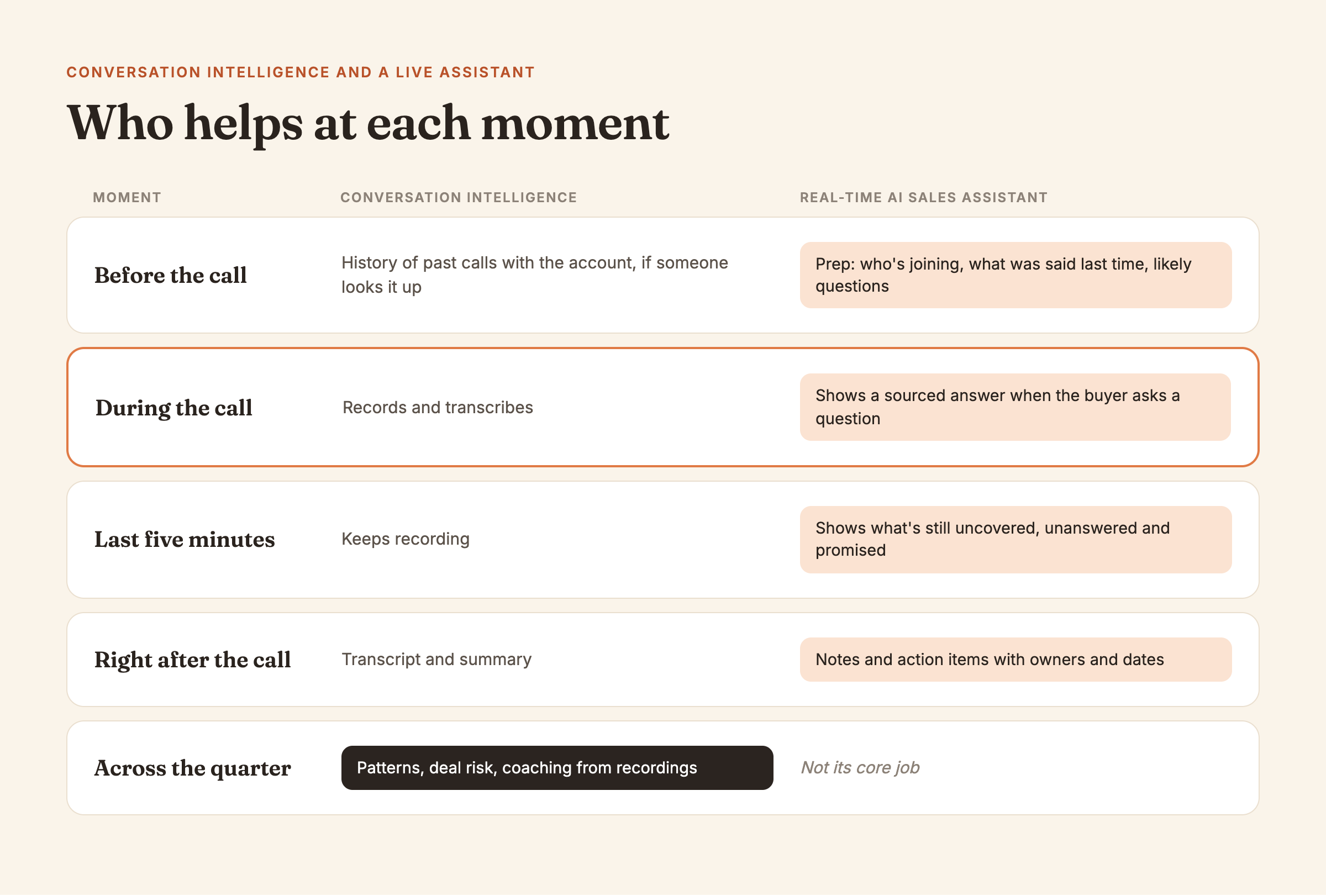
Read it row by row and the overlap is small. Both help after the call, mostly with notes and summaries. Before and during the call, and across the quarter, they do very different things. For a definition of the live side in more depth, see what a real-time sales assistant is.
How does a live assistant sit next to conversation intelligence?
The best setups treat them as a loop, not a choice.
Conversation intelligence finds the gap. Your recordings show that SCIM, data residency and the Salesforce custom object question kept coming up in technical calls this quarter, and reps stalled on all three.
Someone writes the answer down. Usually an SE or product marketing. One clear paragraph each, with a link to the source document.
The live assistant shows it on the next call. The next time a buyer asks about SCIM, the rep sees the documented answer and its source while the buyer is still speaking. They don't have to remember the enablement session from three weeks ago.
Conversation intelligence confirms it worked. Next quarter, the recordings show the question being answered on the call instead of becoming a follow-up email. That's a change you can measure in the tool you already trust.
Each tool makes the other more useful. Conversation intelligence tells you what reps need. The live assistant makes sure they have it in the moment. If integration questions are the ones you keep seeing, our guide to integration and architecture objections covers what the rep should say around the answer.
What about coaching and practice?
Sales coaching software is a third category, built for structured practice: roleplay, scorecards and certifications. It overlaps with conversation intelligence when platforms use real calls to decide what reps should practise next. The question there is whether the rep's mistake is a skill gap, a knowledge gap or a blind spot. We covered how to choose between roleplay, live help and post-call review in a separate post.
The short version for this one: practice builds the skill before the call, conversation intelligence reviews it after, and a live assistant covers the knowledge gap during. They aren't competing for the same minute.
When is conversation intelligence still the better first buy?
I'll be honest about our own lane. If your biggest problem is manager visibility across a large team, a conversation intelligence platform is the better first buy, even over us. A live assistant won't give leadership a team-wide analytics view the way a dedicated platform does.
It's also the better first buy when you don't yet know what's going wrong. If deals are slipping and nobody can say why, start by listening across many calls.
A live assistant earns its place when you already know the moment that costs you: reps who stall on technical, integration or competitor questions, or AEs who can't bring an SE to every call. Often, it's your conversation intelligence that told you so.
Questions to ask before adding a live assistant
If you already run conversation intelligence, ask these before adding anything:
- Do our recordings show reps stalling on the same questions? If yes, that's the case for live help. If no, you may not need it yet.
- Are those answers written down anywhere? A live assistant is only as good as the knowledge you give it. If nobody has documented the answer, fix that first.
- Does every answer show its source? Reps need to trust what they read out. An answer with no source is a guess with good formatting.
- What does it do when it doesn't know? It should stay quiet, not invent something plausible.
- Does it join the meeting as a bot? If your buyers already push back on recording bots, one more will not help.
- Which meeting tools does it work on? Check Zoom, Google Meet, Microsoft Teams and Slack huddles, or whatever your team actually uses.
- Where does it overlap with what we already pay for? If both tools write call notes, decide which one the team uses so nobody keeps two sets.
Where Sunnyside fits
Sunnyside is a real-time AI sales assistant. It runs on the rep's computer and never joins the meeting as a bot. During the call it answers from your product docs, pricing and packaging, battlecards, security and compliance answers, case studies, past calls with the buyer and Slack, and every card names its source. When it doesn't know, it stays quiet. Five minutes before the end, it shows what's still uncovered, unanswered and what you promised. It also preps the call and writes notes after.
It's not a replacement for a conversation intelligence platform's analytics across a large team, and we don't claim it is. For a direct comparison, see Sunnyside vs Gong, or look at the wider field in our Gong alternatives guide.
You can try it on your next call.
Frequently asked questions
What is the difference between an AI sales assistant and conversation intelligence?
Conversation intelligence records and analyses sales calls after they happen to find patterns, coaching moments and deal risk across a team. An AI sales assistant helps the rep during and around the live call, with answers to the buyer's questions, prep before it and notes after it. The first mostly serves managers and leaders. The second mostly serves the person on the call.
If we already use Gong, do we need a real-time sales assistant?
Only if your reps lose ground in the moment, for example stalling on technical, integration or competitor questions while the buyer waits. If your recordings keep showing the same unanswered questions, a live assistant can help on the next call. If your main problem is visibility across the team, the platform you already have may be enough.
Can conversation intelligence help during a live call?
Some vendors add in-call features, so check what yours does today. Most conversation intelligence platforms are built around the recording and the analysis that follows it. Their main strength is what happens across many calls afterwards, not putting a sourced answer on the rep's screen while the buyer is still talking.
Do conversation intelligence and an AI sales assistant overlap?
Yes, mostly in notes, summaries and follow-ups after the call. Judge each tool by its core job first. Conversation intelligence is built for analysis across calls. A real-time assistant is built for the moment during the call. Treat the overlap as a bonus, not the reason to buy either one.
Is sales coaching software the same as conversation intelligence?
No, though they overlap. Conversation intelligence analyses real customer calls. Sales coaching software focuses on structured practice, such as roleplay, scorecards and certifications. Some platforms combine both, using real call analysis to decide what reps should practise next.