

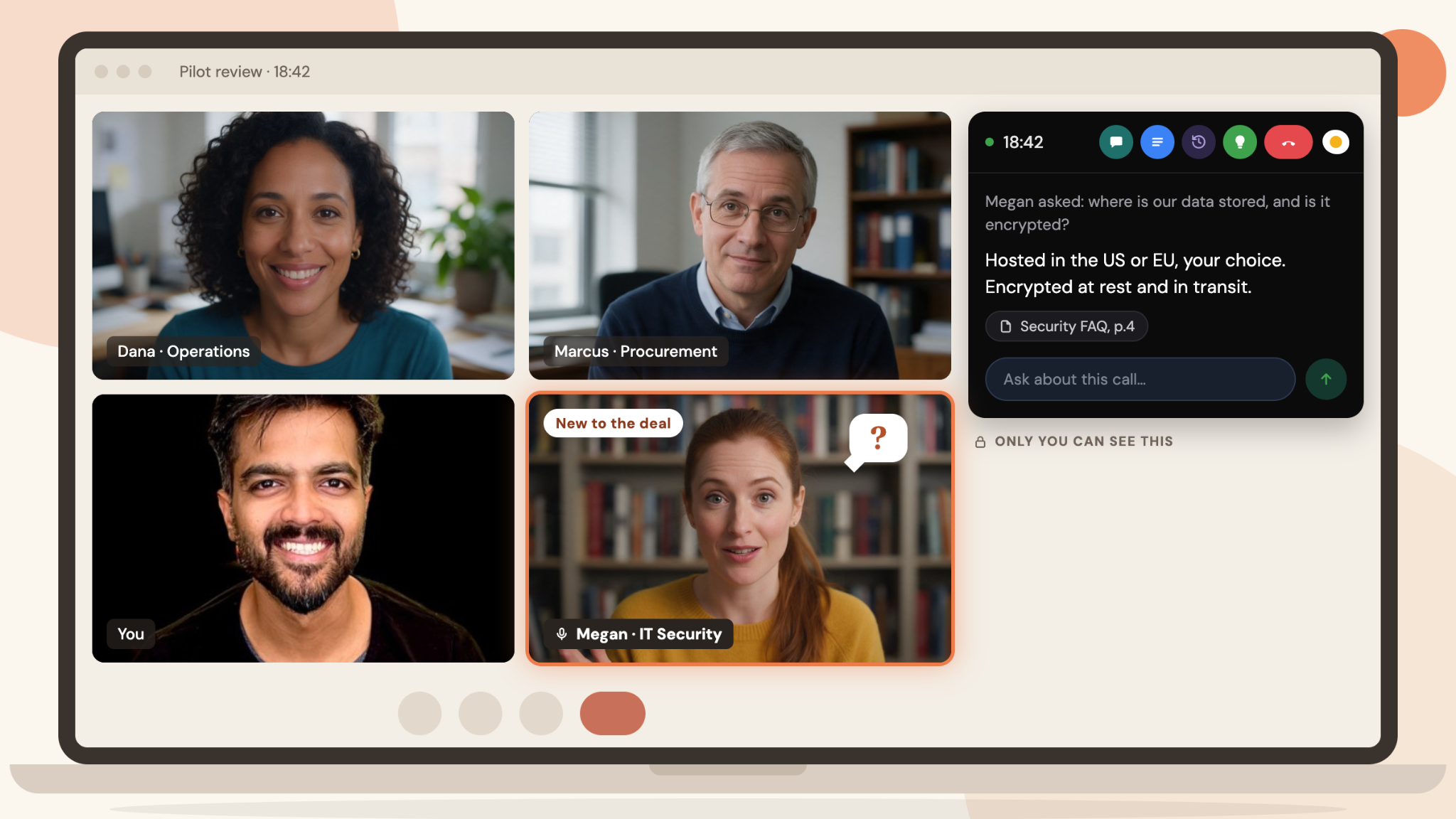
AI sales coaching comes in three forms. AI roleplay lets reps practise against a simulated buyer before the call. Live assistance helps the rep during the real conversation. Post-call coaching reviews what happened afterwards. Choose by the mistake you keep seeing: skill gaps need practice, knowledge gaps need live help, and blind spots need review.
Three different tools, one name
Search for AI sales coaching and you'll find three very different products sold under the same label.
- AI roleplay. The rep practises against an AI playing the buyer. Cold calls, discovery, objections. Nothing is at stake.
- Live assistance, also called real-time sales coaching. The tool listens during a real call and helps the rep while the buyer is talking.
- Post-call coaching. The tool reviews the recording afterwards and shows what went well and what didn't.
The simple way to remember it: roleplay helps a rep practise before the conversation, live assistance helps during the conversation, and post-call coaching helps the rep learn from it.
The mistake I see most often is buying one of these when the team needed another.
Start with the mistake, not the tool
When a deal slips, most managers ask, "What went wrong on that call?" A more useful question is, "What kind of wrong was it?"
In my experience, almost every mistake on a sales call falls into one of three types.
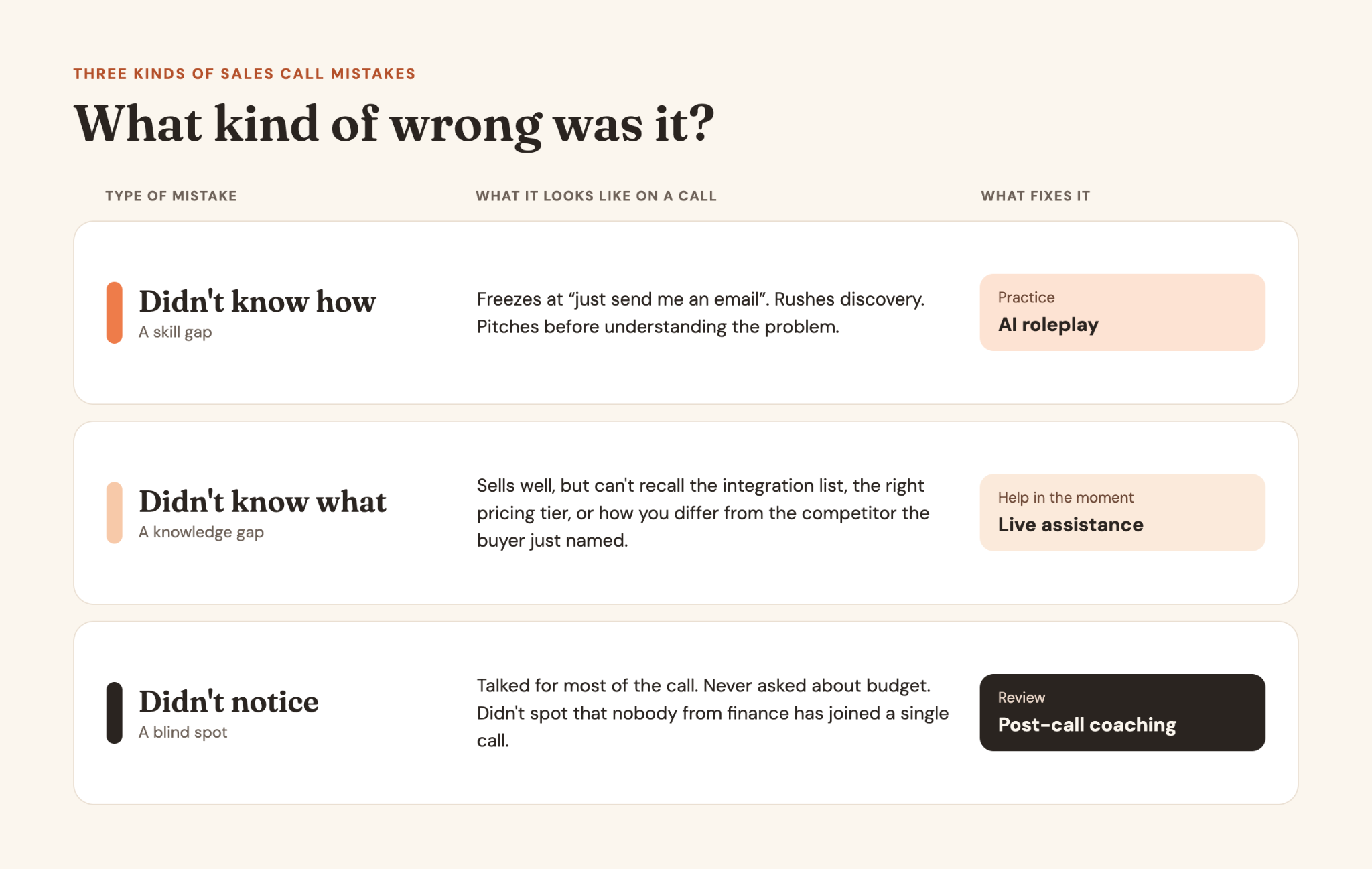
The same rep can make all three. A new hire mostly makes skill mistakes. A strong, tenured rep mostly makes knowledge mistakes, especially the week after a product launch. Everyone has blind spots. Once you know the type, the tool choice becomes much easier.
When AI roleplay makes sense
Roleplay is the right first buy when reps need repetitions and a mistake on a real call would be expensive. Think of a new batch of SDRs, a new pitch before a launch, or the same four objections your team hears every week. A rep can run twenty practice calls in an afternoon without burning a single lead.
That matters more than it used to. Gartner's research found buyers spend only about 17% of their buying journey with suppliers, and when they compare vendors, any one rep may get just 5 to 6% of it. Real conversations are scarce. Practise somewhere else.
The limit is the gap between practice and the real thing. An AI buyer is more patient than a real CFO. It doesn't interrupt twice in the first minute. And no amount of practice gives a rep the answer to a question they've never heard before. We wrote about this in the readiness gap. If you're evaluating roleplay tools, start with our guide to AI sales roleplay.
When live assistance makes sense
Live help fits when your reps know how to sell but can't hold everything in their heads. A long product catalogue. A technical product. Pricing that changed last quarter. A competitor who keeps coming up.
At LinkedIn, the calls where I felt calm were usually the ones where one of our solutions experts joined me. On the other calls, I remember thinking, "I wish I had a friend sitting beside me, someone who could help me without judging me." Live assistance is the closest thing to that I've seen.
The limit is fundamentals. A live prompt can hand a rep the right answer about a competitor, but it can't make them curious, and it can't run discovery for them. A tool that pops up too often can also distract more than it helps. Look for one that stays quiet when it has nothing useful to say. For a worked example of live help on a hard moment, see our piece on when IT and Finance join the call.
When post-call coaching makes sense
Post-call review works at the level of patterns. One manager can't listen to forty calls a week, but software can, and it can show who keeps skipping budget questions or which objections keep stalling deals.
It also helps your best people. Top performers want feedback too, and they rarely get it, because managers spend their time on whoever is behind.
The limit is timing. Every insight arrives after the moment it was needed. I've written before about why sales coaching shouldn't be a post-mortem.
Do you need both roleplay and live help?
Most teams end up with two of the three. I think of it as a loop: practise, perform, review. Review finds the gap. Roleplay closes skill gaps. Live help covers knowledge gaps while the rep is still learning.
In practice, it looks something like this:
- Months one to three of a new rep's ramp: lots of roleplay, plus live help on their first real calls.
- After ramp: live help on every call, post-call review once a week with their manager.
- After a product launch or a move into a new market: roleplay the new pitch for a week, and lean on live help for the new questions buyers will ask.
If you can only buy one, buy against your loudest problem. Deals lost to wrong or missing answers point to live help. New reps who are scared of the phone point to roleplay. Managers coaching from gut feeling point to post-call review.
Don't wait for your company to buy it
One more thing, for the reps reading this.
I believe the salespeople who do well over the next few years will be the ones who learn to work with AI early, not the ones waiting for a tool to be rolled out. Salesforce's research found reps spend only about 28% of their week actually selling. Anything that gives you time back, or makes you sharper on the call, is worth trying.
The mindset I'd want on my team is "How can I become a better salesperson?" not "Has my company bought this for me yet?" Try tools. Experiment. If something works, take the results to your manager.
Where Sunnyside fits
Sunnyside focuses on the live and after parts of this loop, plus the prep before. Sunnyside also does roleplay, and its practice calls are built from your actual deals, which most roleplay tools don't offer.
Before a call, it prepares the agenda and the buying group. During the call, Sunnyside's live assist shows answers from your own docs, pricing, battlecards and past calls, with help when the buyer pushes back or a competitor comes up. It runs on your computer and never joins the meeting. After the call, the post-call notes capture next steps and owners, and Pro and Team plans add call coaching after every call. Individual reps can start on their own plan.
If your biggest gap is skill and your reps need practice volume, a dedicated roleplay tool is the right first step. If your reps know how to sell but keep getting caught by the details, see what live help looks like on a real call.
Frequently asked questions
What is AI sales coaching?
AI sales coaching is software that uses AI to help salespeople improve. It covers three types of tools: roleplay tools where reps practise against a simulated buyer, live tools that help reps during real calls, and post-call tools that review recordings and give feedback. Most products focus on one or two of these.
What is the difference between AI roleplay and real-time sales coaching?
AI roleplay happens before the call. The rep practises against an AI buyer, so mistakes cost nothing. Real-time sales coaching happens during a real call. The tool listens and shows the rep answers or prompts while the buyer is talking. Roleplay builds skill and confidence. Real-time coaching fills knowledge gaps in the moment.
Is AI roleplay effective for sales training?
AI roleplay is useful for building skill through repetition, especially for new reps, new pitches and predictable objections. Reps can practise many times without risking a real lead. It is less useful for preparing reps for unexpected questions, because a simulated buyer is usually more patient and predictable than a real one.
Can AI coach a sales rep during a live call?
Yes. Real-time sales assistants listen to the call and show the rep relevant answers, objection responses or reminders on their own screen while the conversation is happening. The buyer doesn't see them. The rep still decides what to say. Good tools show where each answer came from and stay quiet when they have nothing useful.
Do sales teams need both roleplay and live coaching?
Many do, because they solve different problems. Roleplay helps reps who are still building skills. Live coaching helps reps who know how to sell but can't remember every detail during a call. A common pattern is heavy roleplay during ramp, then live help and weekly post-call review once reps are taking real calls.
How do I choose AI sales coaching software?
Start with the mistakes your reps keep making. If they don't know how to handle a situation, choose roleplay. If they know how but can't recall the details, choose live assistance. If managers can't see patterns across calls, choose post-call coaching. Then compare tools within that category on accuracy, ease of use and rep adoption.