


To reduce ramp time for new sales engineers without adding trainers, stop treating onboarding as a classroom event. Put what your best SEs know in one searchable place, let new hires practise realistic calls early, support them during real calls, and give short feedback after every call instead of once a quarter.
Key takeaways
- Ramp is slow because knowledge lives in people's heads, not because new SEs are slow.
- Four levers: knowledge transfer, realistic practice, guided calls and continuous feedback.
- Measure ramp by check-backs per call, not weeks since the start date.
- Live guidance lets new SEs take real calls earlier without putting the deal at risk.
- Senior SEs should review and mentor, not repeat the same explanation forty times.
Week three. A new SE runs her first demo alone. It's going fine until the buyer asks about data residency for their EU customers.
She knows the answer exists. It's in a Slack thread from March, or in a senior SE's head. She says, “Let me check and get back to you.” It's the second time in the call.
I used to dread that sentence. Once in a call is fine. Say it several times and the buyer starts wondering whether you understand your own product. For a new SE, each one also chips away at confidence.
Why does sales engineer ramp take so long?
Because the hard part of the job isn't in the training deck. Product training covers features. Buyers ask about everything around them: edge cases, integration quirks, which competitor claim is true, what the security team will push back on.
That knowledge is tribal. It lives with senior SEs, and their time is the bottleneck. In Salesforce's 2026 State of Sales research, 46% of Gen Z sales professionals said they rarely get feedback on their sales conversations, and 47% said they don't get enough roleplay before customer calls.
Hiring more trainers treats the symptom. The fix is to make expert knowledge available without needing the expert in the room.
A better way to measure ramp: check-backs per call
Most teams measure ramp in weeks. I'd measure it in check-backs.
A check-back is any moment a new SE defers: “Let me confirm,” “I'll ask our architect,” “I'll send that over.” Count them per call and note the topic.
The count tells you three things:
- What to document. If five new hires check back on data residency, that answer belongs in your knowledge base.
- Who needs practice. One rep with many check-backs on pricing needs roleplay on pricing.
- When to let them solo. When check-backs on common topics drop close to zero, the SE is ready for that call type.
Ramp isn't one finish line. It's a set of topics, each closing at its own pace.
Lever 1: Turn tribal knowledge into something searchable
Pull the questions buyers actually asked in last quarter's calls. Write the best answer to each, with an owner and a date. Every check-back from a new SE becomes a new entry.
This is boring work. It pays for itself the first time a senior SE doesn't get the same Slack message for the tenth time.
Lever 2: Practise realistic calls before real ones
Roleplay works when it uses real objections from your own deals, not generic scripts. AI roleplay helps here because practice no longer depends on a senior SE's calendar. We've written a longer guide on AI sales roleplay if you're evaluating it.
Lever 3: Replace endless shadowing with guided calls
Shadowing shows a new SE what good looks like. It doesn't teach them to perform under pressure. A better path:
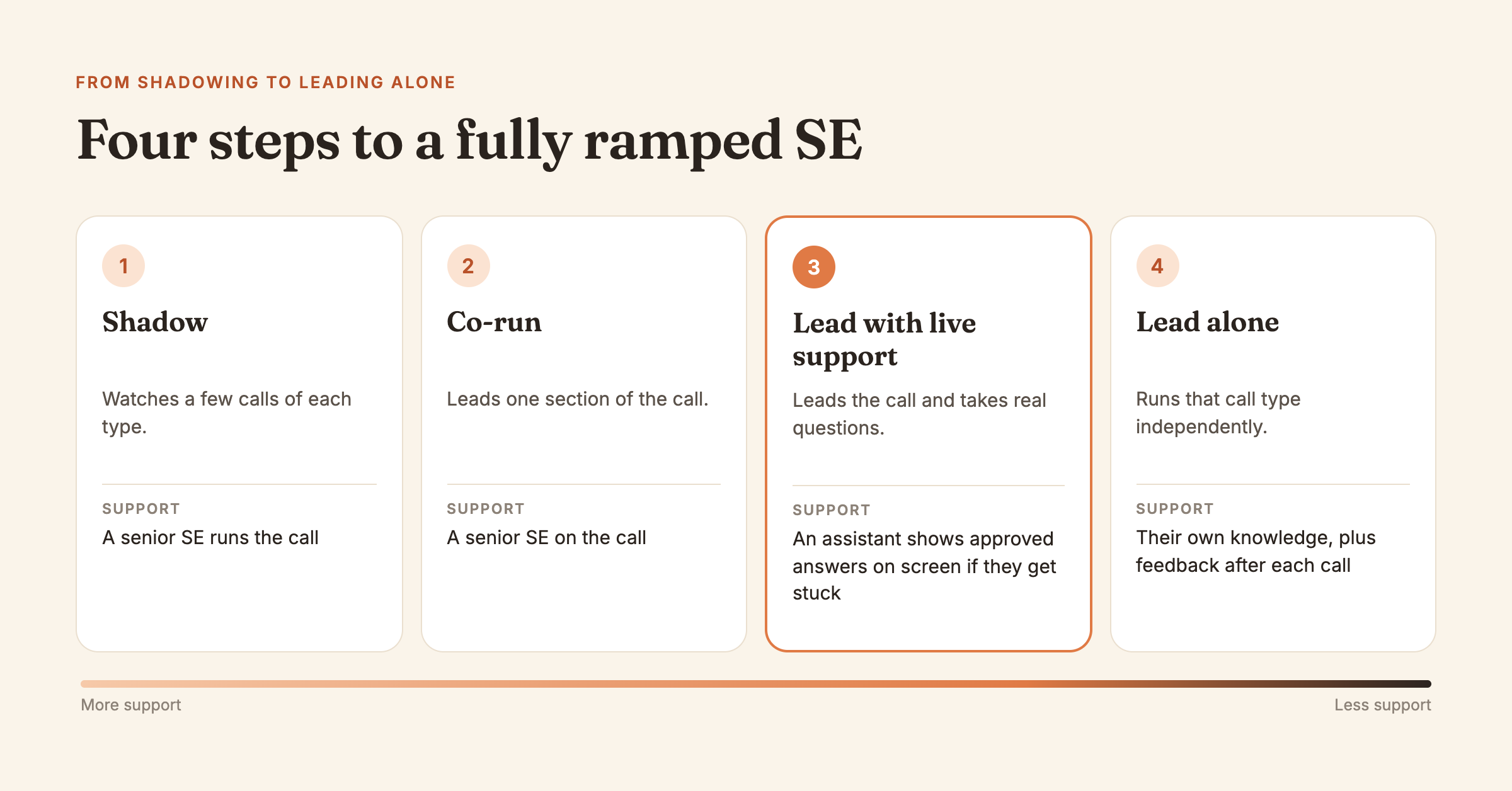
Step three is where most of the time is saved. The new SE takes real calls weeks earlier, with a safety net instead of a senior SE on every invite. If you're new to the idea, what a real-time sales assistant is explains how live support works.
Lever 4: Feedback after every call, not every quarter
Keep it to three questions, answered in five minutes:
- What did the buyer ask that you couldn't answer?
- What did you promise?
- What would you do differently next time?
AI meeting notes make this fast, because the questions and promises are already written down. Our piece on the readiness gap covers why training alone doesn't stick.
What should senior SEs still own?
Judgement. Architecture reviews, deal strategy, the hard calls with demanding buyers, and teaching new SEs how to think, not just what to say. Docs and AI should remove repetition from a senior SE's week, not remove the senior SE. Our post on an AI copilot for sales engineers covers where that line sits.
Where Sunnyside fits
Sunnyside supports step three directly. During a call it shows answers from your product docs, past calls and Slack, names the source on each card, and stays quiet when it doesn't know. Five minutes before the end it lists what went unanswered and what was promised, which becomes your check-back list. After the call, notes and action items with owners are ready.
Try it with your next new hire and count the check-backs.
Next in the technical sales series: "Will It Work With Our Stack?" Handling Integration and Architecture Objections.
Frequently asked questions
What is a good ramp time for a new sales engineer?
There is no reliable single benchmark, because ramp depends on product complexity, sales cycle length and the SE's prior experience. A more useful approach is to set your own baseline: track how long new SEs take to run each call type with few check-backs, then work to shorten that number.
How do you onboard a new sales engineer quickly?
Combine four things: a searchable bank of real buyer questions and answers, roleplay built on your own deals, a guided path from shadowing to leading calls with live support, and short feedback after every call. Together these reduce dependence on senior SEs' time, which is usually the real bottleneck.
Can AI replace sales engineer training?
No. AI can make knowledge easier to find, provide practice on demand and support new SEs during live calls. It can't teach judgement, solution design or how to read a difficult buyer. Those still come from experienced SEs and managers. AI frees their time for that teaching.
What is the difference between shadowing and guided calls?
In shadowing, the new sales engineer watches an experienced colleague run the call. In a guided call, the new SE leads the conversation while getting support, either from a colleague on the call or from a live assistant showing approved answers. Guided calls build real skill faster because the new SE does the work.
How do you measure sales engineer readiness?
Track check-backs per call: how often the new SE defers a question to someone else, and on which topics. When check-backs on common topics drop close to zero for a call type, the SE is ready to run that call alone. This is more precise than counting weeks since the start date.