

Key takeaways
- AI sales roleplay is practice, not pipeline. Reps talk to an AI persona that plays the buyer, get scored against a rubric, and re-attempt. Reps-to-comfort at volume, without burning real prospects.
- Cold calls deserve their own practice mode. Different objections, 30-second pacing, gatekeeper logic. Reps who only practice warm conversations freeze on the first live cold call.
- Free tiers exist but stop short of what a team needs. Fine for one rep self-onboarding; team rollouts need manager dashboards, scenario authoring, and stack integrations the free tier never includes.
- Seven criteria decide whether the tool works: sub-300ms voice latency, scenario authoring, customizable rubric, manager reporting, stack integrations, closed-loop coaching, and a sane pricing model.
- Most rollouts stall at week 2 for rollout reasons, not tooling reasons. No manager visibility, no consequences, no link between practice and the deals reps are losing.
If you're Googling "AI sales roleplay" right now, you're not researching. You're shopping. There's a new rep ramping next week, or your quota is already on fire, and you need something that works by Monday.
The old way of training reps is broken. You rehearse in front of a mirror, shadow a senior AE, then wait three days for your manager to find time to listen to the recording and give you "feedback" that's mostly vibes. By then the deal is dead. So is the learning.
This isn't a pitch — it's a buyer's guide. We'll cover what AI sales roleplay actually is, the seven things to check before you buy one, and the specific failure modes that kill most rollouts by week 2. If you only have ten minutes, skip to the evaluation criteria. That's the part most vendors don't want you to read.
What is AI sales roleplay?
AI sales roleplay is a practice modality where a rep talks to an AI persona that plays the buyer. An LLM drives the persona's behavior: what they care about, how they push back, what answers move them forward. Voice synthesis makes the call feel real-time, and a rubric scores the conversation after the rep hangs up.
A typical session flows like this:
- The rep picks a scenario from a library: discovery call, cold opener, renewal save, whatever they're weak at.
- The AI persona joins a voice call. Latency matters here: anything above 300ms and the rep can feel the lag, which kills the realism.
- The rep delivers their pitch, opener, or discovery questions the same way they would on a live call.
- The persona raises realistic objections, varied per session so reps can't memorize answers. Same scenario on Tuesday won't give the same pushback it gave on Monday.
- A rubric scores the call against criteria the team actually cares about: discovery depth, objection handling, talk-to-listen ratio, whether the next step got booked.
- The rep gets a debrief with timestamps tied to specific moments, plus an optional re-attempt to fix what broke.
Concrete example. SDR Maya is three weeks into the role, practicing a discovery call into a CFO at a 200-person SaaS evaluating expense management tools. Two minutes in, the persona says, "We already use Ramp and it's fine. Why are we even having this call?" Maya stumbles, pivots to features, never asks what "fine" actually means. The scorecard afterward flags one strength (she opened with a strong reference to their recent funding round), one gap (she answered the objection instead of investigating it), and one specific next step: re-run the same scenario and ask at least two follow-up questions before pitching anything.
That gap has a name — passive listening — and it's the single most drillable behavior in roleplay, because it shows up as a number (talk ratio, follow-up question count) on every scored call.

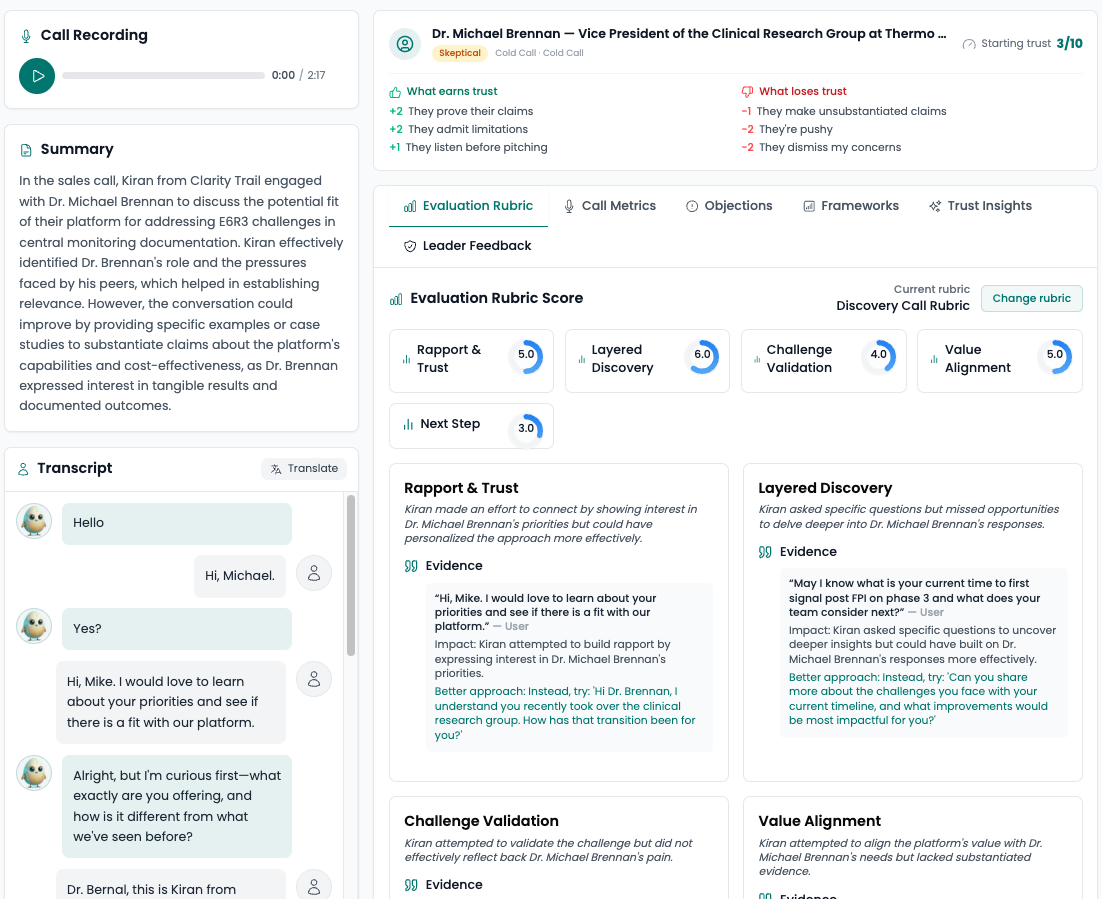
That loop (scenario, call, score, re-attempt) is what every AI sales roleplay product is selling, including Sunnyside Simulation. The differences are in how realistic the persona is, how honest the rubric is, and how fast the rep can iterate. We'll get into those next.
AI cold-calling roleplay
Cold calls are their own discipline, and they need their own practice mode. Discovery calls assume the prospect already wants to talk to you. Cold calls assume the opposite, and almost everything about the conversation flows from that one fact.
The objection set is different. On a discovery call you hear "tell me about pricing" or "how does this compare to X." On a cold call you hear "not interested," "just send me an email," or "we already have a vendor." Reps who only practice warm conversations freeze the first time a prospect cuts them off at hello.
The pacing is different too. A cold call gives the rep maybe 30 seconds to earn the next five. Miss the pattern interrupt, miss the reason for the call, and the prospect is gone. Discovery calls forgive a slow start. Cold calls don't.
Gatekeeper logic is its own subgenre. Receptionists, voicemail trees, a mobile pickup from someone walking into a meeting. Each one needs a different opener, and reps learn the shape by repetition.
That's where AI cold-call roleplay earns its keep: reps-to-comfort, at volume. A new SDR can run 30 cold-opener attempts in an hour against varied objections without burning a single real prospect.
Concrete example. SDR Jordan is drilling a permission-based opener into VPs of RevOps. Run one: the persona says "I'm in the middle of something, what is this about?" Run two, same opener: "we already use Gong, not interested." Run three: straight to voicemail. By attempt 20, Jordan has heard the four objections that actually matter and has a clean answer for each — built on the same acknowledge-anchor-advance pattern every objection responds to.
Is there free AI sales roleplay?
Yes. Most major tools in this category offer a free tier or a free trial. The caps vary: number of personas you can talk to, sessions per month, length of each call, or whether your teammates can see what you practiced.
Pricing pages change constantly. Don't trust any single article on this (including this one). Open each vendor's pricing page yourself before you decide.
What free tiers usually don't include: team analytics, manager dashboards, the ability to author your own scenarios, and the deeper integrations into your CRM or call recording stack. Free is built to get one rep hooked, not to run a team off it.
Free is enough when a single rep is self-onboarding, when someone is learning the category for the first time, or when a sales leader is validating whether AI roleplay is worth a budget line at all. Those are good use cases. Use the free tier hard.
Free isn't enough when you're rolling out to a team, when a manager needs visibility into who's actually practicing and what's working, or when the scenarios need to mirror your specific sales motion instead of a generic SaaS discovery call.
Free is a fine place to start. It's a bad place to deploy a team.
How to evaluate AI sales roleplay tools: 7 criteria
Buying criteria, in order of how much they actually matter. Score every vendor on each before you sign anything.
Tip: what to ask on a vendor demo call. Have the rep on the demo run an actual practice session in front of you, on your headset, with one of your real reps. Not a polished sales engineer walking through a scripted scenario. If the vendor can't or won't do that, the product probably isn't ready for your team.
1. Voice latency and persona realism
Sub-300ms response is the floor. Slower and reps treat it like a chatbot rather than a buyer, which kills the muscle-memory you're paying to build. Test before you buy: time the gap between the rep finishing a sentence and the persona responding, on a real call with a real headset.
2. Scenario authoring — can your sales motion be modeled?
Off-the-shelf personas are fine for generic SDR training. Niche verticals, regulated industries, or multi-stakeholder enterprise deals need a real scenario builder where you control the persona, the objections, and the buying context. Tools like Hyperbound lean on a stock library; ask whether you can author the exact calls your reps actually make on a Tuesday.
3. Scoring rubric — fixed or customizable?
A fixed rubric works for the first 30 days. After that you'll want criteria tied to YOUR qualification framework: MEDDIC, SPIN, command-of-the-message, or your own homegrown checklist. A locked rubric produces meaningless scores within a quarter, and reps stop trusting the numbers. If you can't edit the criteria, you can't coach against them.
4. Manager reporting and team analytics
Single-rep practice is table stakes. The differentiator is the manager view: who practiced this week, where the team's weak spots cluster, and whether last week's coaching moved the metric on actual calls. Mindtickle is strongest here; most newer entrants ship a learner dashboard and call the manager view a roadmap item.
5. Integration with your stack
CRM (Salesforce, HubSpot), dialer (Aircall, RingCentral), call recording (Gong, Chorus), SSO. The tool that lives inside your existing workflow gets used. The one that needs its own tab and its own login gets opened week one and forgotten by week three. Ask the vendor for a list of live customer integrations, not a logo wall.
6. Closed-loop coaching
Most tools train in a vacuum. The bigger win is real call data feeding back into what the rep practices next, so today's roleplay targets exactly the gap from yesterday's blown call. Second Nature is one of the few pushing in this direction, and it's where the category is heading.
7. Pricing model — per-seat or usage-based?
Per-seat is predictable but punishes you for adding the SDRs you most need to train. Usage-based scales with cohorts but makes budgeting harder and surprises finance in month three. Ask for both quotes side by side. If a vendor refuses to show you the second option, that tells you something about the contract.
Best for SDRs vs. AEs vs. CSMs
The role changes what "good practice" looks like. A tool that's great for one cohort can be wrong for another.
For SDRs
Volume matters. A new SDR needs 50 cold-call reps in their first two weeks, not five. Look for deep cold-call scenario libraries, fast objection variation, and a UI that lets a rep run back-to-back attempts without clicking through five menus. The metric to watch is reps-per-hour, not session length.
For AEs
Depth matters. A discovery call runs 45 minutes with three stakeholders, each with their own agenda. Look for multi-persona scenarios where the rep talks to a CFO, a champion, and a skeptical end user in the same call. Longer-form rubrics matter too: MEDDIC, SPICED, command-of-the-message variants, not a generic five-point checklist.
For CSMs
Renewal and expansion is a different game. The objection set is different: "we're not using it enough," "your competitor reached out last week," "budget got cut in half." Practicing net-new prospect calls won't help a CSM save a renewal. Look for persona libraries that include existing-customer scenarios, usage-data context, and the unique pressure of a contract clock ticking.
See Sunnyside in action
Book a 30-minute demo. We'll run a live roleplay against your hardest objection and show you the scorecard.
Why most rollouts stall by week 2
Most teams don't fail at picking a tool. They fail at making it stick. Three patterns kill rollouts, and they're predictable.
-
No manager visibility. Reps practice, and managers can't see who, what, or how well. Without a dashboard the manager checks on Monday morning, the tool fades into the background. Managers stop pushing it, reps stop opening it, and the contract renews into a ghost subscription.
-
No real consequences. If practice scores don't feed into onboarding milestones, ramp plans, or one-on-ones, it's optional homework. Optional homework doesn't get done. Worse, the reps who need it most are the ones least likely to volunteer for it, so the gap widens instead of closing.
-
No closed loop. Reps practice generic scenarios that don't match the deals they're actually losing this week. A rep who just blew a CFO discovery doesn't need a generic cold-call drill. They need to re-run that exact call against a CFO persona, today. When the practice doesn't connect to the pipeline, "go practice" feels like busywork by week two.
These aren't tooling problems. They're rollout problems. The tool that survives past week 2 is the one that solves all three by default, not the one with the longest feature list.
Where Sunnyside fits
We built Sunnyside Simulation against the three failure modes above, because we kept watching teams hit them with every other tool on the market.
Manager dashboards from day one. No manager visibility is failure mode one, so the manager view ships in the free trial, not as a Q3 roadmap promise. Heads of sales see who practiced this week, who skipped, where the team is clustering on weak spots, and whether last Monday's coaching actually moved the score. If you can't pull it up before your 1:1s, it doesn't exist.
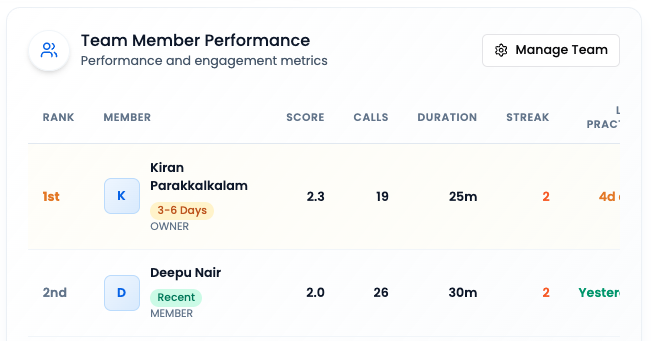
Scorecards tie into onboarding milestones. Practice with no stakes gets ignored. Sunnyside lets you wire scorecard thresholds into ramp plans, so a new SDR doesn't graduate from week one until their cold-opener score clears the bar your team set. The reps who need it most can't quietly opt out.
Closed-loop coaching. This is the part we care about most. Sunnyside Simulation and our call-analysis product share the same data layer, so the AI knows which objections a rep actually blew on Tuesday's live call and serves up tomorrow's roleplay against that exact gap. Practice stops being generic homework and starts targeting the deals on the board this week.
Beyond that: real voice synthesis at sub-300ms, a scenario builder so you can model your sales motion (not generic SaaS), and integrations into Salesforce, HubSpot, Gong, and the major dialers so it lives inside the workflow reps already use.
FAQ
Does AI sales roleplay replace live calls?
No. AI sales roleplay is practice, not pipeline. Reps still need live calls to close deals and read the room with real buyers. What roleplay replaces is the cost of learning on those live calls. A new SDR can drill 30 cold openers against varied objections before dialing a real prospect, so the first real call isn't also their first attempt. Practice raises the floor; live calls are still where revenue happens.
Is sales call practice AI worth it for a small sales team?
Yes, if the team is ramping reps or losing deals to fixable mistakes. The typical fit is 5 to 50 reps: large enough that one-on-one coaching from the manager doesn't scale, small enough that a single weak SDR is a meaningful drag on the number. Teams under five reps can usually get by with shadowing and call review. Above that, the math on a practice tool starts working fast.
What does an AI sales trainer do?
An AI sales trainer is the broader system: scenario libraries, scoring rubrics, manager dashboards, and the feedback loop into live call data. Roleplay is one modality inside it, the conversational practice piece. A full trainer also handles onboarding milestones, certification gates, and reporting on whether practice moved the metric on real calls. Roleplay without the surrounding system is a demo. The trainer is what makes it stick.