


The deal was going fine until minute three. The buyer says, "Look, this is probably too expensive for us." The rep, trying to be helpful, jumps straight to the discount. The deal doesn't close — and the rep never found out the buyer had no budget approved at all, at any price.
That's the cost of bad objection handling. Not lost arguments — lost information. Every objection is a door, and most reps slam it shut by answering too fast.
This is the niche we care most about at Sunnyside, and it's where most sales training is weakest. Here's the pattern that works, and how to apply it to the four objections you hear every week.
What objection handling actually is
Objection handling is how you respond when a buyer pushes back. The instinct is to treat an objection like a debate to win. That instinct is the problem.
A buyer's first objection is rarely their real one. "Too expensive" might mean no budget, I don't see the value yet, or I need a number to justify this internally. Three different concerns, three different responses — and you can't tell which until you ask. (This is the same trap we covered in passive listening: answering the surface and missing what's underneath.)
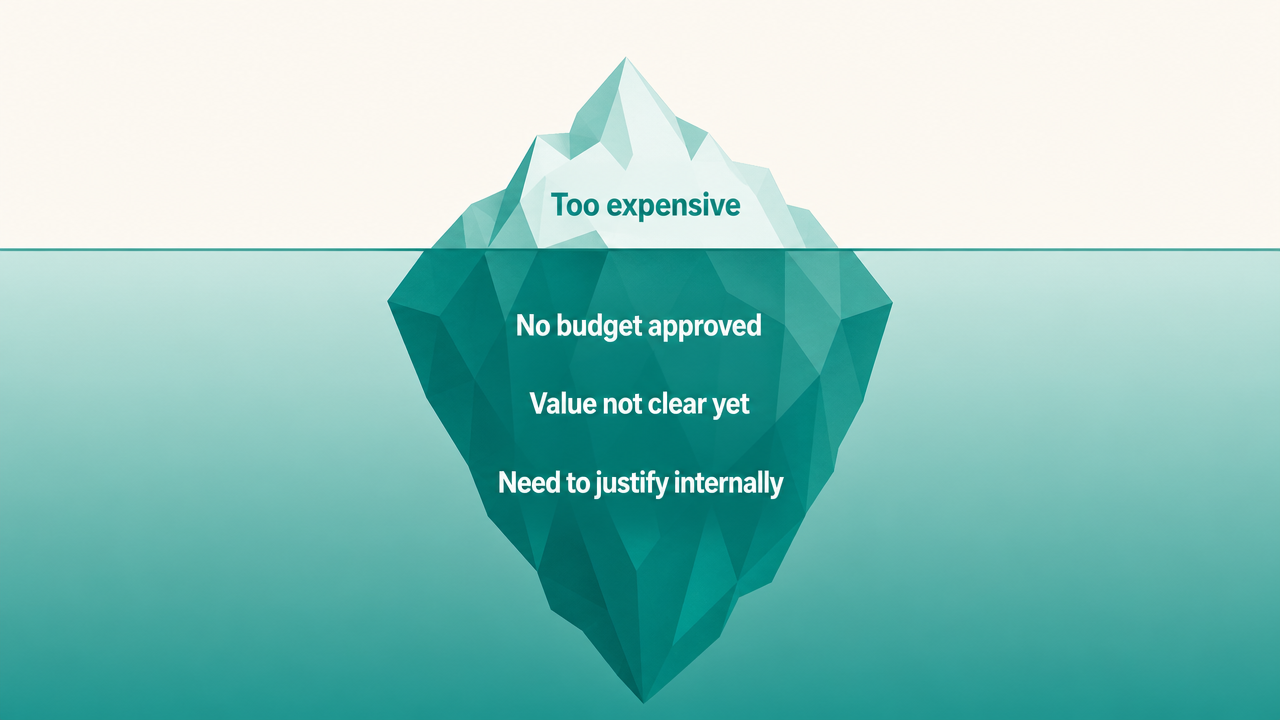
So good objection handling isn't about having a clever comeback. It's about staying curious long enough to find the real concern, then moving the conversation forward.
The pattern: acknowledge, anchor, advance
Every strong objection response has the same three beats. It's the pattern Sunnyside's reports look for when scoring how a rep handled a call.
Step 1
Acknowledge
Show you heard the real concern — without conceding or arguing.
Step 2
Anchor
Tie your response to something the buyer already told you they care about.
Step 3
Advance
End with a question or a concrete next step — never a dead stop.
Acknowledge is not "I totally understand." It's proving you heard the specific concern: "Sounds like budget approval is the real question here, not the product." Anchor connects your answer to their stated priority, which means you need to have done discovery first. Advance keeps momentum — a question that digs deeper, or a small, specific commitment.
Miss the advance and even a great response stalls. The conversation just ends, politely.
The four objections every rep hears
"Not interested"
Almost always a reflex to interruption, not a verdict on your product — especially early in a cold call. Arguing back confirms you're a pest.
Acknowledge the interruption, then earn ten more seconds with one specific, relevant reason to keep talking. "Fair — I called out of nowhere. Most heads of sales I talk to aren't looking until they realize their ramp time is the thing capping this quarter's number. Worth thirty seconds?" You're not handling a real objection yet; you're buying the chance to find one.
"Send me an email"
The polite brush-off. An email with no commitment behind it goes to the same place every other vendor email goes.
Don't refuse — redirect. "Happy to. So I send something useful instead of generic, what's the one thing that would actually make this worth your time?" Now the email is anchored to a real answer, and you've turned a dead end into discovery.
"Too expensive"
The most misread objection in sales. It's rarely about price — it's about value not yet established, or budget that doesn't exist.
Acknowledge without flinching to a discount, then diagnose: "Expensive compared to what?" or "Is it the number, or that the value isn't clear yet?" The answer tells you whether you have a value problem, a budget problem, or a justification problem — and each needs a different move. Lead with a discount and you've solved a problem the buyer may not even have.
"We already use someone"
Information, not a wall. The reps who immediately trash the incumbent sound threatened; the ones who get curious learn whether there's a real reason to switch.
"Good — what's working well, and where does it fall short?" The gap they name is your entire opening. If there's no gap, you've saved both of you a wasted cycle, which is its own kind of win.
You can pressure-test responses to any of these with our free objection handler — paste an objection your team actually hears and compare its diagnostic questions to what your rep said on the last call.
Why scripts fail
The reflex is to hand reps a script: objection on the left, approved comeback on the right. It almost never survives contact with a live call.
Buyers don't phrase objections the way the script expects. The moment the wording shifts, the rep is improvising anyway — except now they're also trying to remember a line. And memorized comebacks sound memorized, which is its own credibility problem.
Learn the pattern, not the lines. A rep who has internalized acknowledge-anchor-advance can handle an objection they've never heard before, because they're running a method, not retrieving a quote. Discovery skills feed this directly — the SPIN question types are how you surface the buyer priorities you'll later anchor to.
How to actually get good at it
Objection handling is a reflex, and reflexes come from reps under pressure — not from reading. That's the case for practice that mirrors a real call.
AI roleplay simulations let a rep face the same objection phrased ten different ways, with a buyer who pushes back differently each session, so they can't memorize their way through. The talk-ratio cap and varied objections build the acknowledge-anchor-advance habit until it holds up live.
Then measure whether it's working. Automated QA flags every objection on every call, how the rep responded, and which handling pattern they used — so you can see across the team whether reps are diagnosing objections or just answering the surface. The full mechanics are in how Sunnyside scores your calls, where clean objection handling earns a scoring bonus when every objection on the call gets the full pattern.
FAQ
What is objection handling in sales?
Objection handling is how a rep responds when a buyer raises a concern, hesitation, or pushback. Good objection handling doesn't argue the concern away — it acknowledges it, anchors to something the buyer cares about, and advances the conversation toward a clear next step.
What are the most common sales objections?
Four show up on almost every team: "not interested", "send me an email", "too expensive", and "we already use someone". Each is usually a reflex, not a final answer — and each has a different real concern underneath that you only reach by asking.
What is the best way to respond to the "not interested" objection?
Don't counter it — acknowledge it, then earn ten more seconds with a specific, relevant reason to keep talking. "Not interested" early in a cold call is a reflex to interruption, not a verdict on your product. The goal is permission to ask one question, not to win the point.
How do you handle the "we already use someone" objection?
Treat it as information, not a wall. Ask what they like about the current solution and where it falls short — the gap is your opening. Reps who immediately attack the incumbent sound threatened; reps who get curious learn whether there's a real reason to switch.
Should sales reps memorize objection-handling scripts?
Learn the pattern, not a script. Memorized lines collapse the moment a buyer phrases an objection differently than the script expected, and they sound canned under pressure. Drilling the acknowledge-anchor-advance pattern against varied phrasing builds a reflex that holds up on a live call.
How can a sales team get better at objection handling?
Practice under realistic pressure and measure it. Reading about objections doesn't change behavior on a live call; repeated reps against an AI buyer who pushes back differently each time does. Then score real calls to see whether the pattern is actually showing up.
Drill objections until they're a reflex
Book a 30-minute demo. We'll run a live AI roleplay that throws your hardest objection at a rep — phrased a new way each time — and score how they handled it.