


Two reps hear the same sentence from a buyer: "We already have a tool for this and it's fine."
The first rep nods, says "totally understand," and pivots into the pricing slide. The second asks: "When you say fine — what would have to break for it to stop being fine?" Same call, same objection. One of them just learned why this deal will or won't close. The other monopolized the next four minutes with a pitch nobody asked for.
The first rep isn't lazy or rude. They're a passive listener — and most sales teams have more of them than they think.
What is passive listening?
Passive listening is hearing someone without processing or responding to what they say. The words arrive, but nothing happens to them: no follow-up question, no paraphrase, no change in what the listener says next.
Active listening is the opposite — engaging with what you heard and proving it. The distinction is old; Harvard Business Review was writing about businesspeople retaining only half of what they hear back in 1957. What's changed is that on recorded sales calls, you can now see it.
| Behavior | Passive listener | Active listener |
|---|---|---|
| Buyer raises a concern | "Totally understand." Moves on. | Asks a follow-up question before responding |
| Buyer goes quiet | Fills the silence with pitch | Waits — lets the buyer finish the thought |
| Buyer uses a vague word ("fine," "soon," "expensive") | Accepts it | Asks what the word actually means |
| Next sentence | Was planned before the call | Depends on what the buyer just said |
| After the call | Remembers what they said | Remembers what the buyer said |
The last row is the tell. Ask a rep what the buyer said on yesterday's call. Passive listeners reconstruct their own talk track.
The monopolizing trap: passive listeners talk more
Here's the part that fools managers: passive listening doesn't look like silence. It looks like a rep who monopolizes the call.
It makes sense when you think about it. A rep who isn't working with the buyer's words has nothing to respond to — so they fill the space with the only material they have: their pitch. Long monologues, stacked features, answers to questions nobody asked. The buyer becomes an audience.
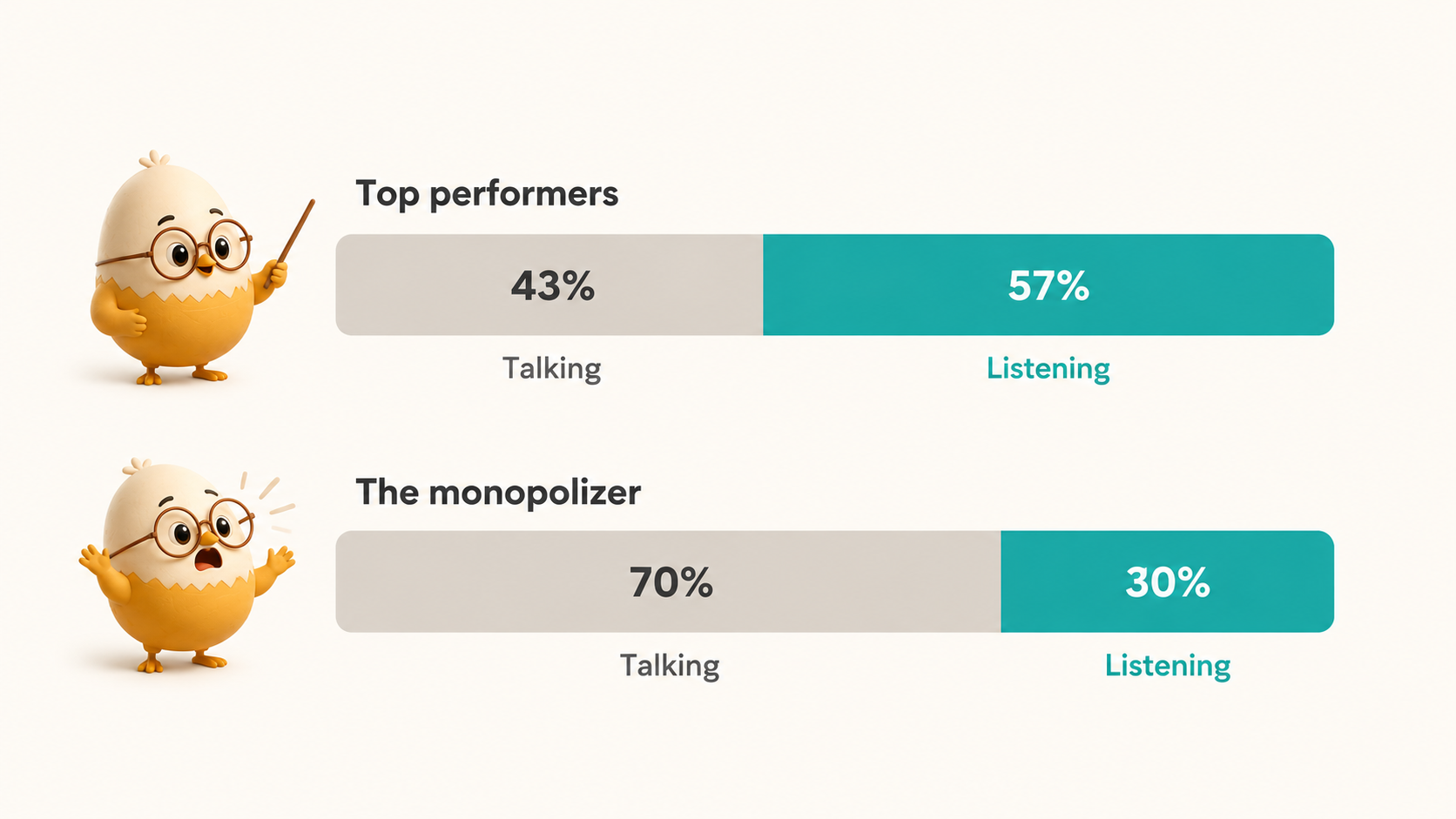
The numbers back this up. Gong's analysis of B2B sales calls found that top-performing reps talk roughly 43% of the time and listen for 57% — and win rates drop as talk time climbs. A rep at 65–75% talk time isn't "good at presenting." They're passively listening and actively monopolizing.
This gives you something most listening advice doesn't: a number. Talk-to-listen ratio is measurable on every recorded call, which means passive listening stops being a personality judgment and becomes a coachable metric. If you run automated call QA, it's a metric you can track for the whole team without listening to a single recording yourself.
Where it actually costs you: objection moments
Passive listening is survivable in a product demo. It's fatal at objection moments — and this is the part most listening content never touches.
Every objection has two layers. The surface objection is what the buyer says. The real objection is what's underneath it, and it only comes out if someone asks. "We already use a tool and it's fine" might mean the contract renews in March, my boss picked it and I can't criticize it, or we barely use it and I don't want to admit that. Three different objections. Three completely different next moves. (Once you've found the real one, there's a repeatable pattern for the response itself — see our guide to handling sales objections.)
A passive listener answers the surface every time — usually with a feature comparison, delivered fast, at length. The deal dies politely three weeks later. An active listener asks one or two follow-up questions first, because the diagnosis matters more than the response.
You can see the difference in your own pipeline. Pull three lost-deal calls and find the first objection in each. Did the rep ask a single question before responding? If you want to pressure-test how your team responds to specific objections, run a few through our free objection handler — and if reps don't know what to ask instead of answering, the discovery question generator is the faster fix than a workshop.
Try it on a real objection from your pipeline
Paste an objection your team hears weekly into the free objection handler. Compare its diagnostic questions against what your rep actually said.
Open the objection handler →How to diagnose passive listening on your team's calls
You don't need to relisten to a hundred recordings. Four signals catch almost every passive listener, and all four are countable:
- Talk ratio above 60%. The single most reliable flag. Best reps sit near 43:57 talk-to-listen; chronic 65%+ is monopolizing.
- Fewer than two follow-up questions per discovery call. Not scripted questions — questions that only exist because of something the buyer said.
- Monologues over 90 seconds. Past the 90-second mark, the rep is presenting, not conversing.
- Objections answered within five seconds. A near-instant answer means no processing happened. The pause that feels awkward to the rep reads as consideration to the buyer.
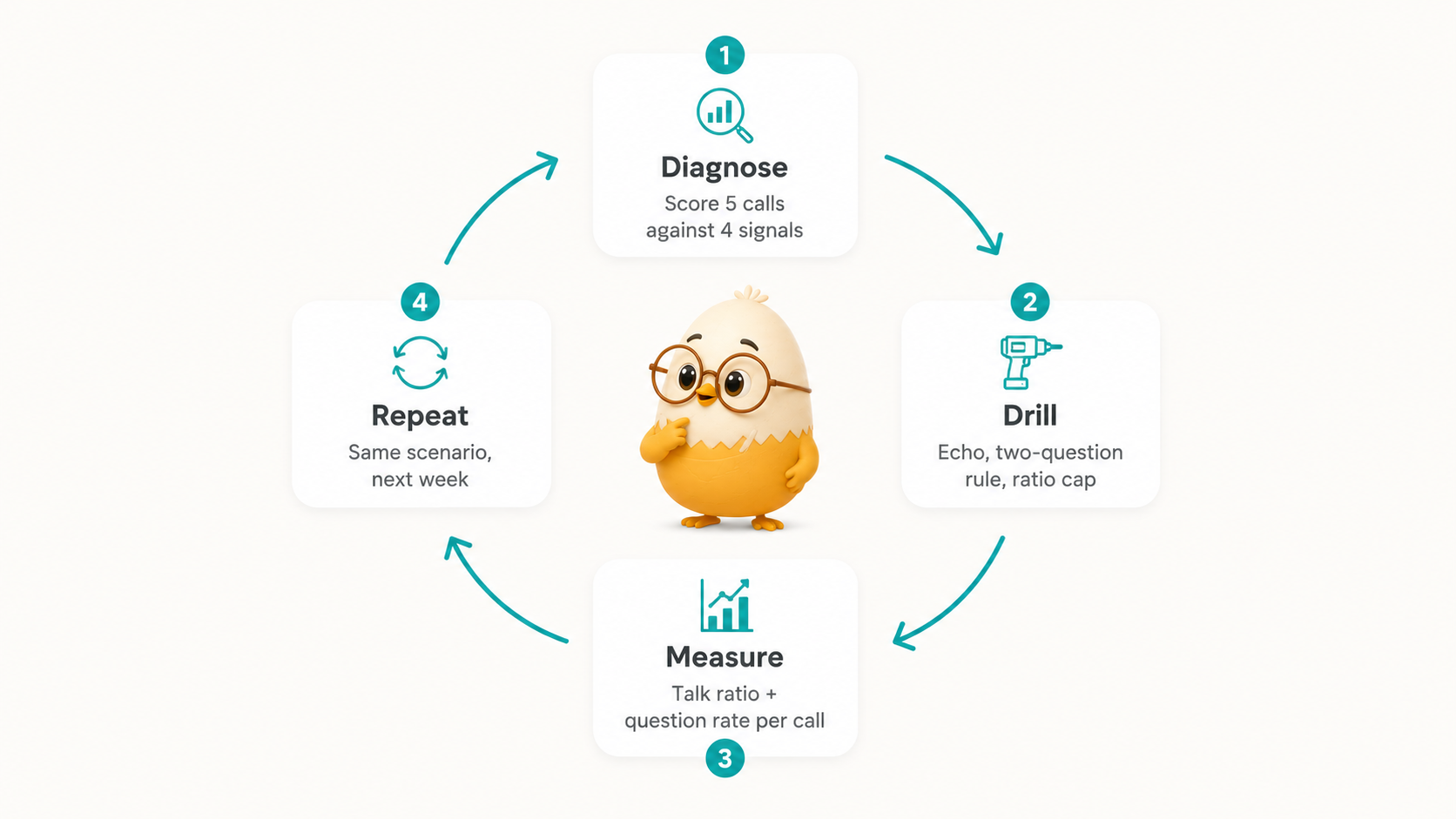
Score a sample of five calls per rep against these four signals and you'll know exactly who needs the drills below. (This is the kind of rubric automated QA applies to every call automatically — talk ratio, question counts, and monologue length per rep, per week.)
Five drills that fix it
Knowing the definition changes nothing. Listening is motor memory — it improves the way cold calling improves: through reps, not reading.
1. The echo drill. Before responding to anything substantive, the rep repeats the buyer's last key phrase back as a question. Buyer: "It's just not a priority this quarter." Rep: "Not a priority this quarter?" It feels mechanical for a week, then becomes the reflex that buys thinking time.
2. The two-question rule. No objection gets answered until the rep has asked two follow-up questions about it. Enforce it in roleplay first, then live. This single rule converts more passive listeners than any training deck because it makes the diagnostic behavior mandatory.
3. The talk-ratio cap. Run a roleplay where the rep fails automatically if they exceed 50% talk time. Reps discover within minutes how much of their talking is filler. This is hard to do with a colleague playing buyer and trivial with AI roleplay simulations, where the scenario can enforce the cap and the persona keeps producing realistic material to listen to.
4. The three-second silence. After the buyer stops talking, the rep counts three seconds before speaking. Half the time, the buyer keeps going — and the second half of the thought is where the real objection lives.
5. The weekly self-review. Each rep pulls one of their own calls per week and counts their four diagnostic signals from the section above. Self-scored numbers stick better than manager feedback on the same numbers.
Reading about listening vs. drilling it
Most of what ranks for "passive listening" is definitional — accurate, and inert. Here's the honest comparison between consuming that content and practicing the skill:
| Reading about it | Drilling it | |
|---|---|---|
| Rep knows the definition | Yes | Yes |
| Behavior changes on live calls | Rarely | Within 2–3 weeks of reps |
| Progress is measurable | No | Talk ratio + question rate, per call |
| Works at objection moments | No — pressure reverts habits | Yes — that's what gets drilled |
| Manager effort | Forwarding an article | A rubric and a practice cadence |
If you're building that practice cadence from scratch, our complete guide to AI sales roleplay covers how to structure it — including why most rollouts stall at week two.
FAQ
What is passive listening?
Passive listening is hearing someone without processing or responding to what they say. The listener stays quiet, doesn't ask follow-up questions, and doesn't check their understanding. In sales calls, it shows up as a rep who lets the buyer talk, then continues their pitch as if nothing was said.
What is the difference between passive and active listening in sales?
A passive listener receives words; an active listener works with them. Active listeners ask follow-up questions, paraphrase what they heard, and let what the buyer said change what they say next. The fastest test: did the rep's next sentence depend on the buyer's last one?
Is passive listening ever useful?
Yes — when your only job is to absorb, like sitting in on a call review or letting a frustrated customer vent before responding. It fails in discovery and objection handling, where the information you don't chase is usually the information that decides the deal.
What is a passive listener?
A passive listener is someone who hears without engaging — no follow-up questions, no paraphrasing, no reaction that proves they processed what was said. On sales teams, passive listeners are often the reps who talk the most: because they're not working with the buyer's words, they fill the space with their own.
How do I stop monopolizing sales conversations?
Measure first: if you're talking more than 60% of the call, you're monopolizing it. Then practice with constraints — cap your talk ratio in roleplays, force two follow-up questions before answering any objection, and leave three seconds of silence after the buyer stops talking.
What is a good talk-to-listen ratio for sales calls?
Gong's analysis of B2B sales calls found top performers talk about 43% of the time and listen for 57%. You don't need that exact number — but a rep consistently above 60% talk time is monopolizing the call, and it's the most reliable early signal of passive listening.
Hear what your reps actually sound like
Book a 30-minute demo. We'll run a live AI roleplay with a talk-ratio cap and show you the listening metrics on every call your team already makes.