


"We trained them. We gave them the playbooks. They passed the certification. But the moment they get on a real prospect call, everything falls apart."
If you've led a sales team, you've probably said something similar.
In my conversations with sales leaders over the years, this comes up far more often than you'd imagine. And I don't say that as an outsider. Having led sales teams myself, I've faced the same challenge. We invested time in onboarding, training, playbooks, and certifications, only to find that some reps still froze when the conversation became unpredictable.
The problem usually isn't that the reps are bad. It's that training and sales readiness are two very different things.
Training teaches knowledge. Readiness is about knowing what to do when the pressure hits. That's the gap most organizations overlook.
So how do you know if your reps are actually ready? Here are five signs they aren't — and what you can do about it.
1. They Ask No Discovery Questions
Reps jump straight into the pitch instead of understanding the prospect's world.
What's really happening? Anxiety. With limited time, they default to what feels safest — the pitch.
Why it matters: Without discovery, you're solving a problem the customer hasn't admitted they have.
What to do: Discovery is built through deliberate practice. Reps need repeated opportunities to ask open-ended questions, become comfortable with silence, and learn to explore pain before presenting a solution. If a rep doesn't know what to ask instead of pitching, a discovery question generator gives them a starting set to rehearse against — faster than waiting for the next workshop.
2. They Shut Down When You Coach Them
When feedback feels personal, improvement slows. Replace judgment with curiosity by asking, "What was your thinking?" rather than "Why didn't you…?" Create a safe environment where reps can fail during practice instead of on live customer calls. AI roleplay simulations help here precisely because the failure happens with a bot, not a prospect — reps can get it wrong ten times before it counts.
3. They Talk Too Much
Talking feels like control, but great salespeople know silence creates space for prospects to think. Measure talk-to-listen ratios and encourage reps to speak for no more than 60 seconds before asking another question. This one has a number attached, which makes it coachable: the reps who talk the most are often the ones listening the least. We wrote about why that quietly kills deals in passive listening in sales.
4. They Panic When They Hear an Objection
Objections are information, not rejection. Don't just teach responses — practice the top objections repeatedly until confidence replaces hesitation. Every objection also has two layers: the surface objection and the real one underneath it, and reps only reach the second by asking. Our complete guide to handling sales objections breaks down that pattern.
Drill the objections your team hears every week
Paste an objection your reps freeze on into the free objection handler. Compare its diagnostic questions against what your rep actually said on the last call they lost.
Open the objection handler →5. Their Energy Drops Halfway Through the Call
Conversation stamina develops through repetition. The more realistic conversations reps have before meeting customers, the more natural live calls become — and the less a 40-minute call drains them by the halfway mark.
What These Behaviors Are Really Costing You
It's easy to dismiss these as isolated coaching issues, but together they have a measurable business impact.
When reps skip discovery, opportunities stall and sales cycles become longer. When coaching doesn't land, managers spend more time repeating the same feedback. When reps dominate conversations, prospects feel pitched to rather than understood. When objections aren't handled well, deals end prematurely. And when energy drops midway through a call, opportunities quietly disappear.
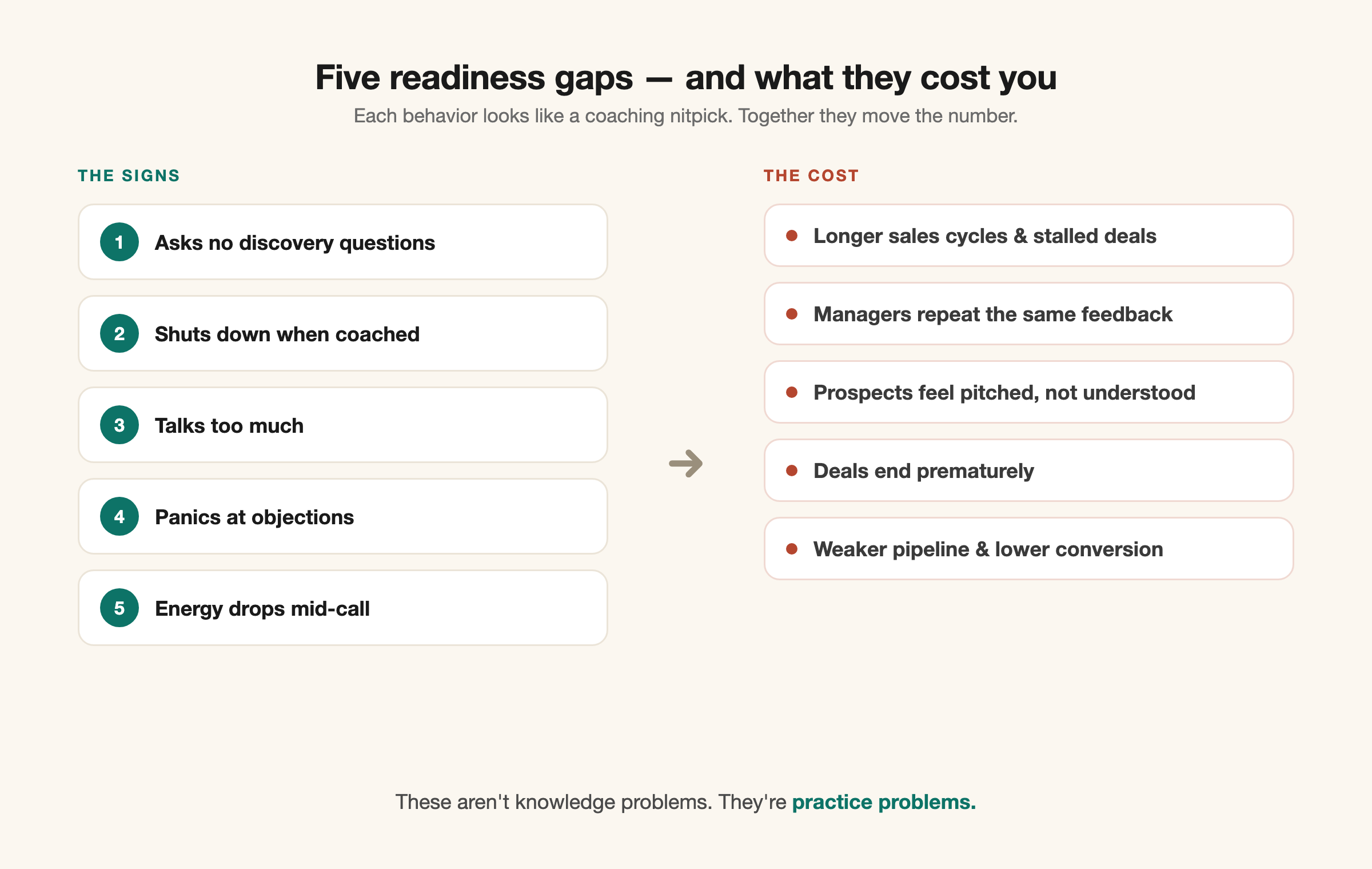
The result is lower conversion rates, longer sales cycles, weaker qualified pipeline, more coaching effort with limited improvement, and revenue that's often blamed on pricing or competition rather than execution. Most of these signals are visible in the calls your team already records — the kind of behavioral pattern automated call QA can flag across every rep without a manager relistening to a single recording.
The irony is that many organizations respond with more training. But these aren't knowledge problems — they are practice problems.
What's Really Going On
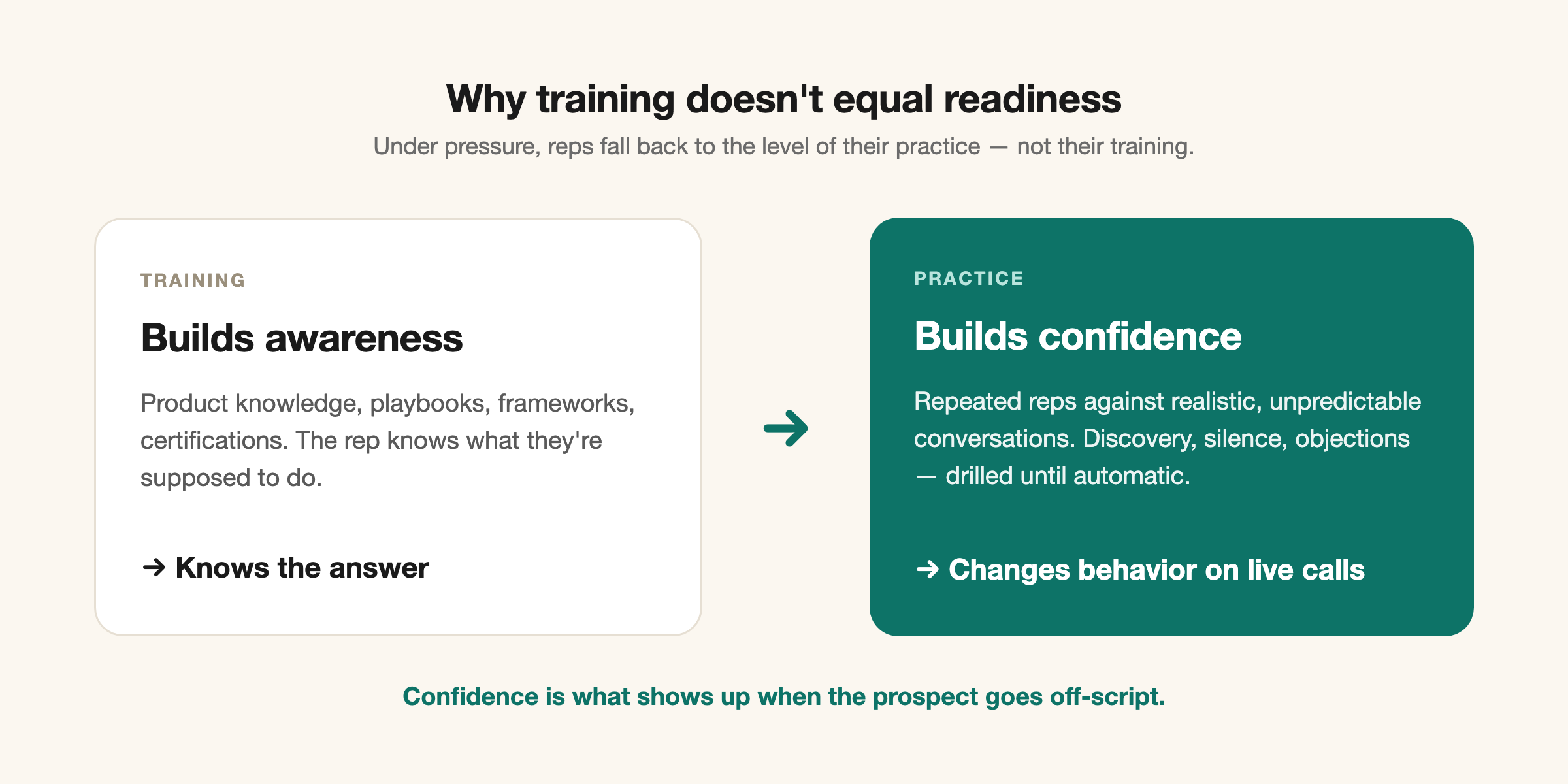
Most reps already know the product, the pitch, and the frameworks. Under pressure, however, people don't rise to the level of their training — they fall back to the level of their practice. Training builds awareness. Practice builds confidence. Confidence changes behavior.
How to Close the Gap Between Training and Readiness
Start by reviewing real customer conversations and looking for behavioral patterns rather than script adherence.
Coach one behavior at a time instead of overwhelming reps with feedback.
Replace more classroom training with deliberate practice through peer roleplays, manager coaching, AI simulations, and objection drills.
Measure progress by comparing future calls against previous ones. Are reps asking better questions? Handling objections more confidently? Listening more?
Finally, make practice part of your team's culture. The best sales teams don't treat practice as an onboarding activity — they make it a weekly habit. If you're building that cadence from scratch, our complete guide to AI sales roleplay covers how to structure it, including why most rollouts stall at week two.
Final Thoughts
The biggest mistake sales organizations make is assuming training automatically creates readiness. It doesn't.
Training teaches people what to do. Practice teaches them how to do it when the stakes are real.
The best reps aren't always the smartest. They're the ones who've practiced enough that real customer conversations no longer feel unfamiliar.
A Challenge for Sales Leaders
This week, pick one rep and listen to two customer calls. Don't score product knowledge. Look for the five behaviors discussed above. Then ask yourself one question:
Has this rep actually practiced handling these situations, or have they simply been trained to expect them?
The answer will tell you whether your team is truly sales-ready or simply well-trained.
FAQ
What is the difference between sales training and sales readiness?
Training teaches knowledge — the product, the pitch, the frameworks. Readiness is knowing what to do when the conversation turns unpredictable and the pressure hits. Training builds awareness; practice builds the confidence that changes behavior on a live call. A rep can pass every certification and still not be ready.
Why do reps freeze on live calls after passing training?
Under pressure, people don't rise to the level of their training — they fall back to the level of their practice. A rep who has only ever heard the objection in a slide deck has no rehearsed response to reach for, so anxiety takes over and they default to the pitch. The fix is repetition against realistic scenarios, not more classroom time.
What is a good talk-to-listen ratio for sales calls?
Top-performing reps talk roughly 43% of the time and listen for 57%. You don't need that exact split, but a rep consistently above 60% talk time is dominating the conversation rather than understanding the prospect. Encourage reps to speak for no more than 60 seconds before asking another question.
How do I coach a rep without them shutting down?
Replace judgment with curiosity. Ask "What was your thinking?" instead of "Why didn't you…?" When feedback feels personal, improvement slows. Create an environment where reps can fail during practice instead of on live customer calls, so coaching becomes something they seek out rather than dread.
How do you practice objection handling?
Don't just teach responses — drill the top objections repeatedly until confidence replaces hesitation. List the five to ten objections your team hears every week, then run reps through each one in roleplay or AI simulation until the response is automatic. Objections are information, not rejection, and the rep needs enough reps to feel that.
How often should sales teams practice?
The best sales teams treat practice as a weekly habit, not a one-time onboarding activity. Make deliberate practice — peer roleplays, manager coaching, AI simulations, objection drills — part of the team's culture so real customer conversations stop feeling unfamiliar.
Find out if your reps are actually ready
Book a 30-minute demo. We'll run a live AI roleplay with one of your real scenarios and show you the readiness signals — discovery, talk ratio, objection handling — on every call your team already makes.