

When I was in sales and account management at LinkedIn, our managers had a coaching target. Every day they were expected to listen to a set number of recorded calls and leave a comment on each one.
Each manager had eight to ten reps. Each rep was on calls most of the day. So the managers did what anyone would do: they played the recordings at 2x or 3x speed, skimmed the AI summary, and picked a few calls to comment on. By the time a pointer reached the rep in a one-on-one, the deal had usually moved on. Sometimes it was already lost.
I was one of those reps. I never got feedback after a call. I got a summary.
That gap between what sales coaching is supposed to be and what actually happens is the real problem AI sales coaching has to solve. Recording more calls doesn't fix it, and neither do better dashboards. This guide explains why the traditional model breaks, what good AI sales coaching looks like in 2027, and how sales leaders can make it stick.
THE SHORT ANSWER
AI sales coaching uses AI to give sales reps feedback before, during and after their customer conversations, based on every call rather than the few a manager has time to review. Done well, it gives reps specific feedback within minutes, spots patterns across many calls, and tells managers where to spend their limited coaching time.
Why Traditional Sales Coaching Breaks
Every sales leader agrees coaching matters. Almost nobody gets enough of it. In Salesforce's State of Sales research, only 26% of sales professionals said one-on-one coaching happens weekly (source: Salesforce State of Sales). The reasons are structural, not a lack of effort.
The math doesn't work
Take a manager with ten reps, each doing three customer calls a day. That's about 150 calls a week. If each call runs 45 minutes, even at 3x speed, listening to all of them would take a full working week before a single piece of feedback is written. So managers sample, and sampling 10–20% of calls gives you a highlight reel, not coaching. The calls that matter most are the messy ones: where a rep loses momentum halfway through, mishandles an objection, or misses a buying signal and never recovers. Those are exactly the calls nobody has time to find. (I wrote more about this in why sales coaching shouldn't be a post-mortem.)
The timing is wrong
Most coaching happens in a weekly one-on-one, days after the call. By then the buyer has moved on, the rep has forgotten the details, and the feedback becomes a story about the past. A post-mortem after the deal is dead teaches you one thing: how to write a better autopsy. The real comparison is real-time coaching vs post-mortems, and the post-mortem loses.
Summaries are not feedback
This is the one I feel most strongly about. A call summary tells you what happened. Feedback tells you what to do differently next time. When managers can't listen to every call, they lean on the AI summary to decide what to coach, and a summary was never designed to answer that question. "The buyer raised pricing concerns" is a summary. "You answered the pricing question before you understood their budget process; next time, ask who approves spend first" is feedback.
Reps don't ask for it
Here's the uncomfortable truth: salespeople rarely volunteer to be coached. Leaders understand its value; reps experience it as one more meeting, often about a deal they'd rather forget. If coaching is optional, adoption stays low. It has to be part of how the team runs, and it has to be quick and useful enough that reps stop resisting it.
What AI Sales Coaching Should Look Like in 2027
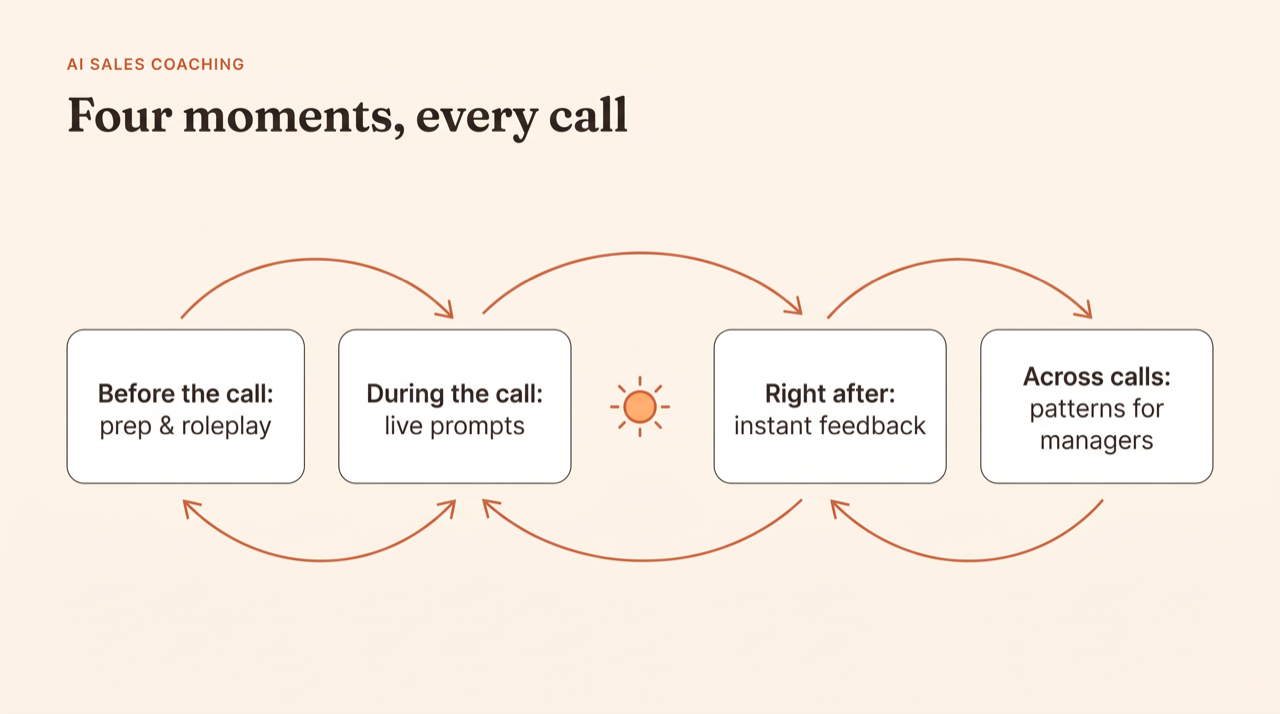
The shift is from occasional coaching on a sample of calls to continuous coaching on every call. In practice that means four moments, each with a different job.
| Moment | What happens | Who it helps |
|---|---|---|
| Before the call | Prep briefs and AI roleplay so reps rehearse the hard conversation first | Reps, especially new hires |
| During the call | Private, live prompts and answers when the buyer asks something hard | Reps in the moment |
| Right after the call | Specific feedback within minutes: what worked, what to change | Reps, while the call is fresh |
| Across many calls | Patterns in each rep's style, surfaced to the manager | Managers deciding where to coach |
1. Before the call: practice, not theory
The best time to fix a weak objection-handling habit is before a real buyer hears it. AI roleplay lets reps rehearse discovery, pricing and technical conversations against a realistic buyer, as many times as they need. It also closes the readiness gap between training that works in theory and calls that go wrong in practice. Our AI sales roleplay guide covers how to set it up.
2. During the call: help while it still matters
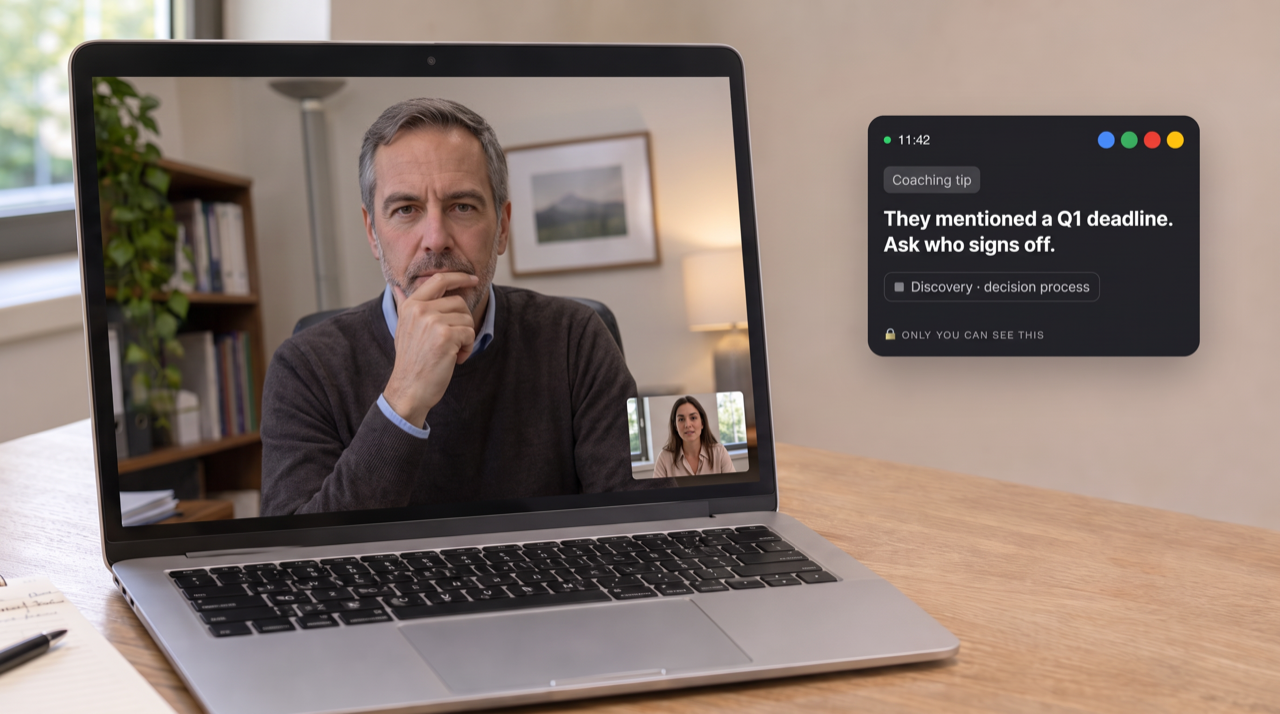
Live coaching sounds intrusive until you've been on a call where the buyer asks something you can't answer. In my years selling technology, the hardest moments were never about effort. They were about having the right information at the right time. A private prompt that reminds a rep to ask about the decision process, or surfaces the answer to a technical question, changes the outcome of the call itself, not the next one. If you're weighing this against human coaching, see AI roleplay vs live sales coaching.
3. Right after the call: feedback in minutes, not days
Imagine finishing a call and, before your next meeting, getting three specific notes: you talked for 70% of the call, you didn't confirm the timeline, and your answer on integrations was strong, so use it again. That's feedback a rep can act on today. It's also the part most conversation intelligence setups skip, because they were built to record and summarise, not to coach.
4. Across many calls: patterns, not one-off comments
One call can be a bad day. Ten calls show a habit. When AI looks across a rep's conversations, it can spot patterns, such as always discounting when price comes up or passive listening in discovery, and send that pattern to the manager. Now the one-on-one is about the one or two habits that matter most, backed by examples, instead of a random call picked at 3x speed.
How Sales Leaders Should Change Their Coaching Model
AI changes the economics of coaching, but the operating model still has to change with it. Here's what I'd recommend to any sales leader rolling this out.
Make it part of the system, not a favour. Coaching shouldn't depend on reps asking for it. Build it into the weekly rhythm, with AI handling the volume so it doesn't become another chore.
Coach patterns, not calls. Use one-on-ones for the two or three habits that show up across many calls, not for retelling a single conversation.
Set a 24-hour rule. Feedback older than a day loses most of its value. If AI gives reps notes within minutes, managers can spend their time on the harder conversations.
Practise before big calls. Ask reps to roleplay a renewal, a security review or a pricing negotiation before the real thing. It's cheaper to lose a practice call.
Measure behaviour, not activity. Stop counting how many calls a manager commented on. Track whether the habits you coached actually changed over the next ten calls.
Common Mistakes With AI Sales Coaching
Treating summaries as coaching. If your "coaching" output is a paragraph describing the call, you have a note-taker, not a coach.
Scoring everything. A 40-point scorecard on every call creates noise. Focus on the few behaviours that move deals in your sales motion.
Coaching only lost deals. Won deals teach just as much, especially about what top reps do differently.
Leaving it optional. Low adoption isn't a tool problem. It's a leadership decision. See the signs your reps aren't ready for live calls if you need the case for making it standard.
Where Sunnyside AI Fits
I built Sunnyside AI because I lived both sides of this problem: the rep who got a summary instead of feedback, and someone who has spent years selling technical products where timing is everything. Sunnyside covers the four moments in one place: AI roleplay and call prep before the call, live call assist during it, call analysis and coaching feedback after it, and conversation intelligence that shows patterns across calls. The goal isn't another dashboard. It's turning what happened on the call into what the rep does better on the next one (Sunnyside AI).
Try it free: 10 days or 5 calls, no card needed (see pricing).
What Comes Next
My view, and it is a view, not a forecast: by 2027 the line between "conversation intelligence" and "coaching" will blur. Recording and summarising calls will be table stakes. The teams that pull ahead will be the ones whose tools help reps change behaviour quickly, while managers spend their time on judgement, not listening at 3x speed. Sales is still run in very traditional ways, and the teams that adopt AI thoughtfully will sell smarter at scale.
Frequently Asked Questions
What is AI sales coaching?
AI sales coaching uses AI to analyse sales conversations and give reps feedback and guidance before, during and after calls. Unlike manual coaching, it can cover every call, not just a sample.
Can AI replace sales managers in coaching?
No. AI handles the volume: reviewing every call, giving fast feedback and spotting patterns. Managers still provide judgement, context and accountability, and they can focus on the coaching conversations that matter most.
How often should sales reps be coached?
Reps benefit from feedback after every important call, which only AI makes practical, plus a regular one-on-one with their manager focused on a few recurring habits.
What is the difference between conversation intelligence and AI sales coaching?
Conversation intelligence records, transcribes and summarises calls. AI sales coaching uses that data to tell reps what to do differently, ideally right after the call or during it. More on the differences in AI sales assistant vs conversation intelligence vs coaching.
Is real-time sales coaching distracting for reps?
It can be if prompts fire constantly. Good live coaching is private, rare and specific: it appears only when the buyer raises something the rep needs help with.