

A good sales follow-up email does three things: it recaps what the buyer said, answers anything left open, and makes the next step easy. Most deals don't die from a bad call; they stall in the days after it, when the follow-up is late, generic or missing the answer the buyer asked for. Below are 12 templates for the moments that matter most in a B2B deal, with timing and subject lines you can copy.
Key Takeaways
- Send it the same day. Follow up within 24 hours of any call, while the buyer still remembers the conversation.
- Use their words. Recap the problem in the buyer's language, not your product's.
- Close every open question. If a security, integration or pricing question went unanswered, the follow-up is where you win it back.
- One clear next step. End with a single, specific ask: a date, a person or a document.
The 5 Rules of a Follow-Up Email That Gets a Reply
- Lead with their priority. Open with the outcome the buyer cares about, not "Just following up."
- Keep it short. A follow-up should be readable on a phone in under a minute.
- Answer what you promised. Every "I'll get back to you on that" from the call goes in the email, answered.
- Make it easy to forward. Your champion will share it internally, so write a recap their boss can understand.
- Ask for one thing. A specific next step beats a vague "Let me know your thoughts."
Following up well is really about keeping deal momentum. And you can only recap what you heard, so active listening on the call matters as much as the email itself.
Follow-Up Timing at a Glance
| Moment | When to send | Goal |
|---|---|---|
| After discovery call | Same day | Confirm the problem and next step |
| After demo | Same day | Tie features to their use case |
| Unanswered technical question | Within 24 hours | Close the gap with a clear answer |
| After IT, security or finance joins | Within 24 hours | Send what each stakeholder needs |
| After sending a proposal | 2–3 business days | Surface concerns early |
| No reply | 3–4 business days, then a week | Restart the thread with value |
| Final follow-up | About 2 weeks after the last one | Get a clear yes, no or later |
Templates After a Sales Call
1. Follow-Up Email After a Discovery Call
When to send: Same day as the call.
Subject: Recap: [their problem] + next steps
Hi [Name],
Thanks for walking me through [their goal or problem] today. Here is what I heard:
- [Priority 1, in their words]
- [Priority 2]
- [Constraint: timeline, budget or stack]
Based on that, I suggest we [next step, e.g. a 30-minute demo focused on X] with [other stakeholder]. Does [date/time] work?
Best,
[Your name]
Why it works: It proves you listened, gives your champion a summary to forward, and proposes one concrete next step.
2. Follow-Up Email After a Demo
When to send: Same day as the demo.
Subject: How [product] handles [their use case]
Hi [Name],
Thanks for the time today. The three things that seemed to matter most to your team:
- [Use case 1] → [how it works, one line]
- [Use case 2] → [how it works]
- [Question raised] → [short answer or link]
I have attached the recording of the [specific part] for anyone who missed it. Next step: [trial setup / technical review] on [date]. Who else should join?
[Your name]
Why it works: It connects the demo to their use cases instead of re-listing features, and invites the rest of the buying group in.
3. Follow-Up When You Couldn't Answer a Technical Question
When to send: Within 24 hours.
Subject: Your question on [integration/API/feature], answered
Hi [Name],
On our call you asked whether [product] works with [their system]. Here is the full answer:
[2–3 sentence answer]
[Link to doc or diagram]
If it helps, our [sales engineer / solutions lead] can walk your team through it on a 20-minute call this week.
[Your name]
Why it works: A fast, precise answer turns a weak moment on the call into proof that you are easy to work with. See how to handle "Will it work with our stack?" moments.
4. Follow-Up After Security or IT Joins the Call
When to send: Within 24 hours.
Subject: Security details for [Company]'s review
Hi [Name],
Thanks for bringing [IT/security contact] in today. As promised, here is what your team asked for:
- Data hosting and region: [answer]
- SSO and user provisioning: [answer]
- Compliance status: [answer, with link to trust page]
- Data use for AI training: [answer]
Happy to fill in your security questionnaire, or set up a call with our team. What is the easiest route for you?
[Your name]
Why it works: Security reviewers want specific, checkable answers. Grouping them in one email speeds up the review. More on handling security questions on sales calls.
5. Follow-Up After Finance Raises Pricing Questions
When to send: Within 24 hours.
Subject: Pricing for [team size/use case], as discussed
Hi [Name],
Following up on [finance contact]'s questions about pricing:
- Cost for [N] users: [amount and billing terms]
- How price changes as you grow: [answer]
- What is included: [onboarding, support, integrations]
I have also added a short ROI summary based on the numbers you shared: [one line]. Would it help to review this with [finance contact] on [date]?
[Your name]
Why it works: Finance buyers want clear numbers and terms, not adjectives. See a rep's guide to IT and finance questions.
Templates for Proposals and Silence
6. Follow-Up After Sending a Proposal
When to send: 2–3 business days after sending.
Subject: Questions on the proposal?
Hi [Name],
Checking in on the proposal I sent on [day]. Two things that often come up at this stage:
- Is the scope right for [their goal]?
- Is there anyone else who needs to review it, such as legal, security or procurement?
Happy to walk through it with your team on [date].
[Your name]
Why it works: It surfaces hidden reviewers and objections before they quietly stall the deal.
7. Follow-Up Email When There's No Response (First Nudge)
When to send: 3–4 business days after your last email.
Subject: Re: [original subject]
Hi [Name],
Bumping this up in case it got buried. One thing I forgot to share: [new, useful item: a customer example, a short answer to their question, a relevant insight].
Still makes sense to [next step] on [date]?
[Your name]
Why it works: Replying in the same thread keeps the context, and adding something new gives them a reason to answer.
8. Second Follow-Up With No Response
When to send: About a week after the first nudge.
Subject: Is [their goal] still a priority?
Hi [Name],
I don't want to keep filling your inbox. Has [their goal] moved down the list, or is the timing just busy right now?
Either answer helps me plan, and I am happy to check back in [month].
[Your name]
Why it works: An honest question about priority is easier to answer than another meeting request.
9. Final ("Breakup") Follow-Up
When to send: About 2 weeks after the last email.
Subject: Should I close your file?
Hi [Name],
I haven't heard back, so I'll assume [their goal] isn't a focus right now and close this out on my side.
If that changes, just reply to this email and we can pick up where we left off.
[Your name]
Why it works: It is polite, removes pressure, and often prompts a reply from buyers who meant to respond.
Templates for Other Key Moments
10. Follow-Up After a No-Show
When to send: Within an hour of the missed meeting.
Subject: Missed you today: new time?
Hi [Name],
Looks like today didn't work out, no problem. Here are two other times: [option 1] or [option 2]. Or grab any slot here: [link].
[Your name]
Why it works: It is short, assumes good intent, and makes rebooking a one-click decision.
11. Follow-Up to Re-Engage a Lost or Stalled Deal
When to send: 3–6 months later, or when something changes.
Subject: [Relevant change] since we last spoke
Hi [Name],
When we spoke in [month], the timing wasn't right because [reason they gave]. Since then, [relevant change: new feature, integration, case study, pricing].
Worth a 15-minute catch-up to see if it fits now?
[Your name]
Why it works: Referencing their original reason shows you remembered, and the change gives a real reason to reopen.
12. Follow-Up to Your Champion Before Their Internal Meeting
When to send: 1–2 days before they present to their team.
Subject: A one-page summary for your [meeting]
Hi [Name],
Ahead of your meeting with [boss/committee], here is a one-page summary you can share:
- The problem: [one line]
- What changes: [one line]
- Cost and timeline: [one line]
- Next step: [one line]
Anything you want me to add or join for?
[Your name]
Why it works: Champions sell for you when you are not in the room. Making their job easy is one of the most effective follow-ups you can send.
How AI Writes Your Follow-Ups for You
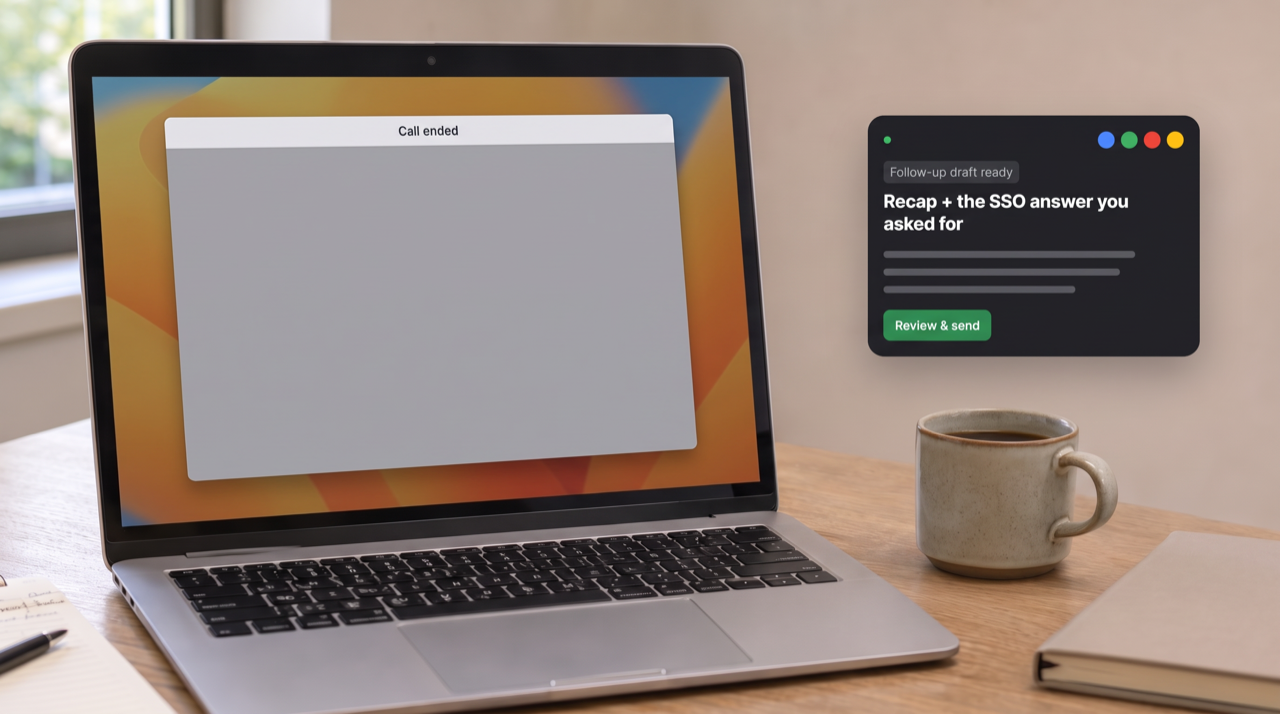
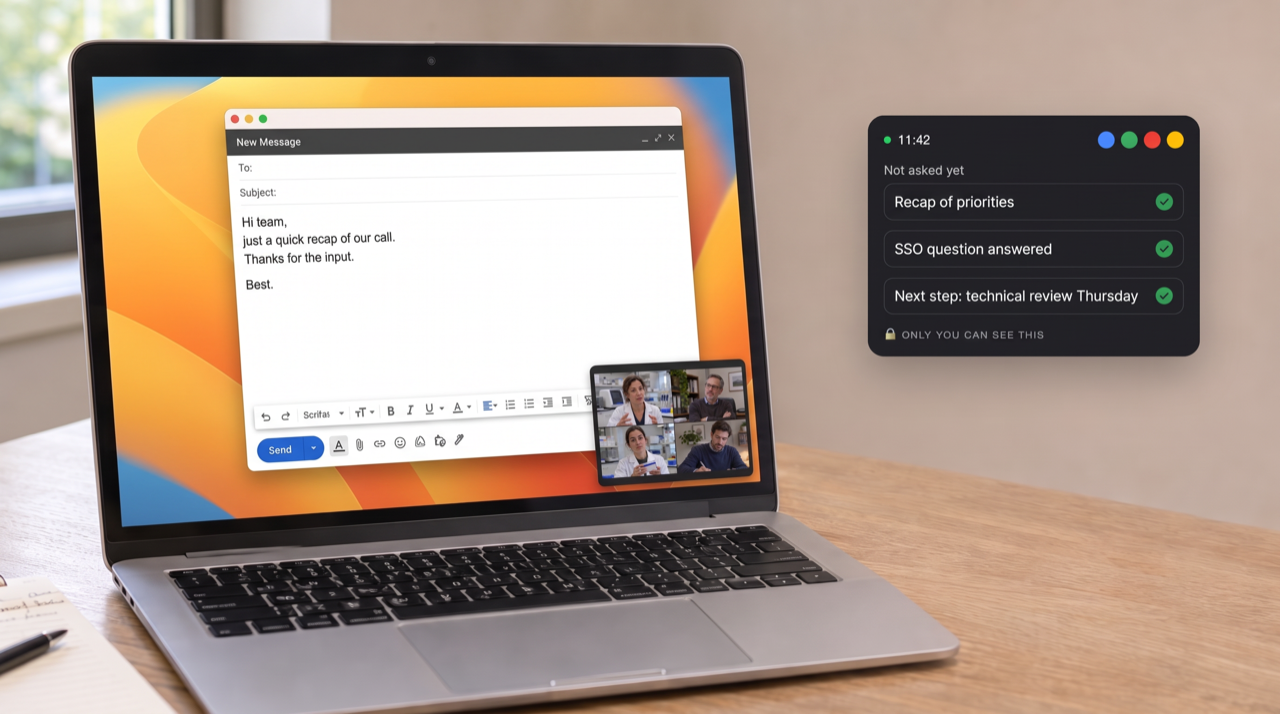
Templates help, but the slowest part of a follow-up is remembering exactly what was said and what you promised. Sunnyside AI handles that. It analyzes the call and drafts the follow-up email after it, including the priorities the buyer raised and the questions that came up, so the rep only has to review and send (Sunnyside AI). For a one-off email, paste your call notes into our free follow-up email writer.
It also helps before the email is needed: during the call, Sunnyside surfaces live answers to technical, security and pricing questions, so fewer questions are left open for the follow-up at all. MetaShot reported getting 5 hours a week back from prep and follow-ups.
Try it free: 10 days or 5 calls, no card needed. Plans start at $19 a month (see pricing).
Frequently Asked Questions
How soon should you send a follow-up email after a sales call?
Send it the same day, ideally within a few hours, while the conversation is fresh for both of you. For a question you need to research, send a short note the same day saying when the full answer will arrive.
How many times should you follow up with no response?
Three to four follow-ups over two to three weeks is a reasonable limit for an active deal. Space them out, add something useful each time, and end with a clear final email.
What should a sales follow-up email include?
A short recap of the buyer's priorities in their words, answers to any open questions, and one specific next step with a date.
How do you write a follow-up email after no response without being pushy?
Reply in the same thread, add something new and useful, and ask an easy question about priority or timing instead of pushing for another meeting.
The Bottom Line
The best follow-up emails are fast, specific and written in the buyer's words. Save these 12 templates, send every follow-up within 24 hours, and close every open question. To learn more about handling the questions that create follow-ups in the first place, read our field guide to sales objections.