

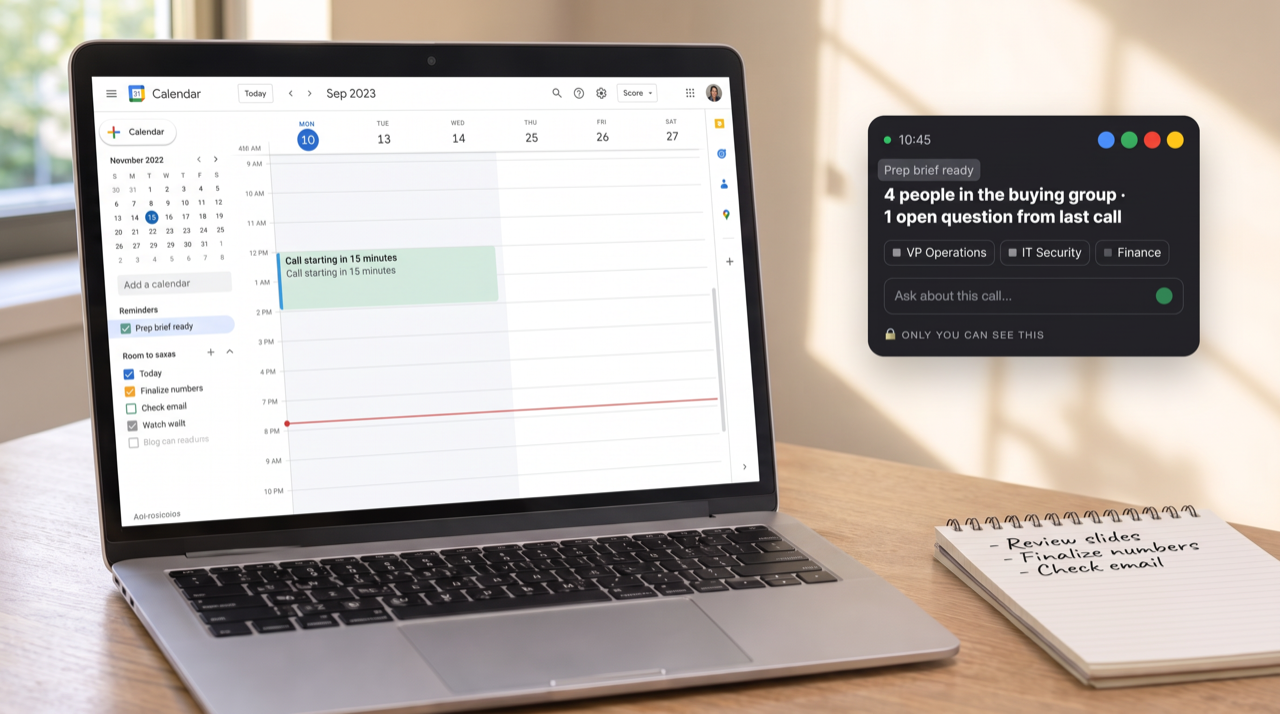
When I worked at LinkedIn, I prepared for calls with Sales Navigator. I could see who I was meeting, who else sat around them, what had changed at the company and where my connections overlapped. I walked into calls knowing the room.
I had that advantage because I worked there. Most reps don't. Premium prospecting tools are expensive, so prep usually comes down to twenty rushed minutes of Googling, a skim of old CRM notes and hope.
That inequality is one of the reasons I built Sunnyside: every rep should be able to walk into a call prepared, not just the ones with the biggest tool budget. Tools aside, good preparation follows a pattern. Here is the checklist I'd give any B2B rep, plus how long each part should take.
THE SHORT ANSWER
To prepare for a sales call, research the account and everyone in the buying group, review every past conversation, set one clear objective, plan your questions, prepare answers to the hard questions you're likely to face, pick one relevant customer story, and decide the exact next step you'll ask for. For most B2B calls, 20 to 30 minutes of focused prep is enough.
Why Most Sales Call Prep Falls Short
Most reps prepare for the company and forget the people. They know the revenue, the funding round and the product lines, then get surprised when an IT security lead joins and starts asking about data residency.
The other common gap is memory. Deals involve many conversations over weeks or months. If the rep doesn't remember what the buyer said last time, or what they promised to send, the buyer notices. Nothing slows deal momentum like a buyer repeating themselves.
Good prep fixes both: you know who will be in the room, and you remember everything that has already been said. It also means you're ready for the questions that break technical calls when you don't have an answer.
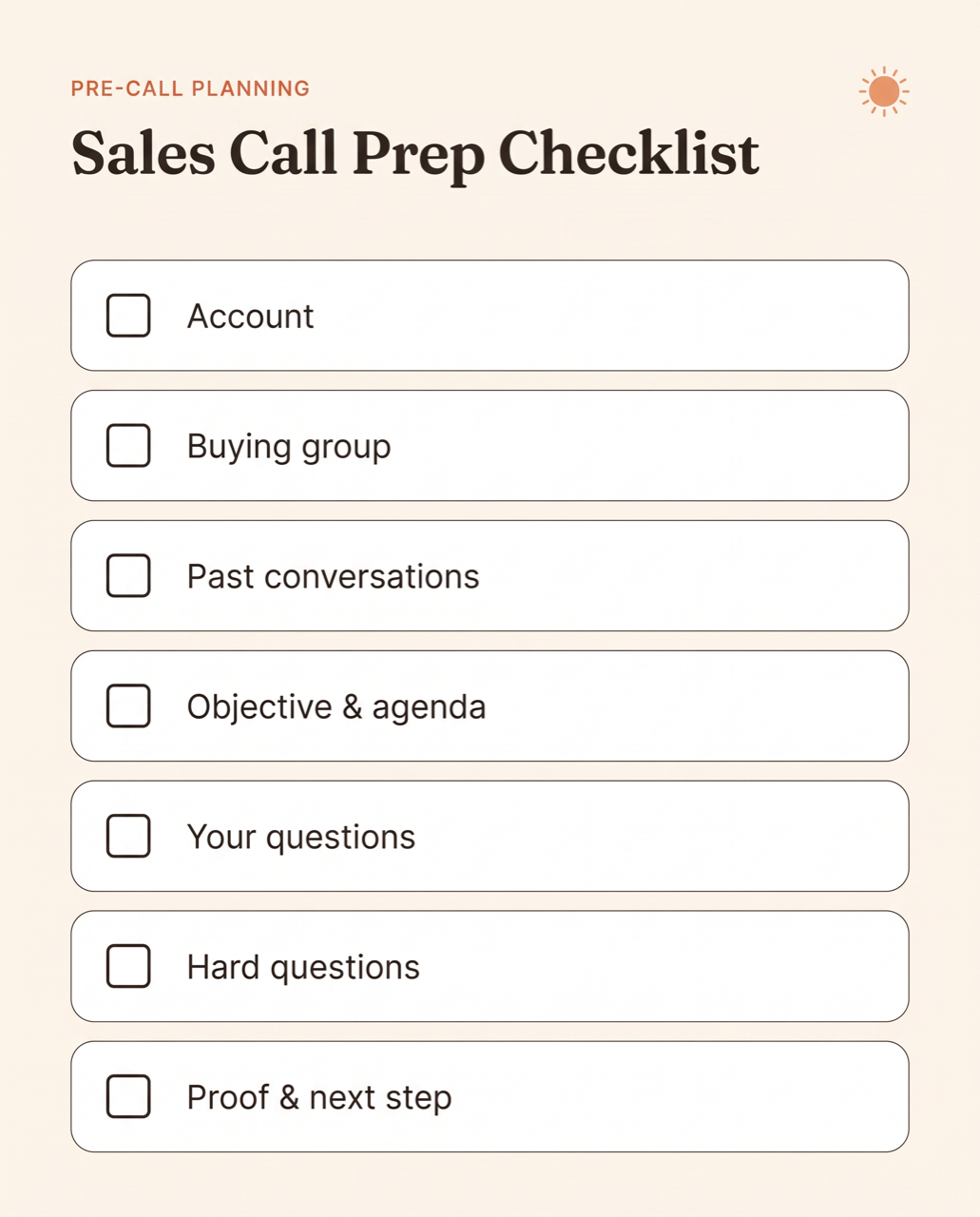
The Sales Call Prep Checklist
1. The account
- What does the company sell, and how has it changed in the last 6 to 12 months (news, funding, hiring, leadership changes)?
- What are its stated priorities this year? Earnings calls, press releases and job posts often say it plainly.
- What tools and systems do they use today, and what would yours replace or connect to?
- What is your history with them: past deals, current customers in other teams, open support issues?
2. The buying group
- Who is on the invite, and what is each person's role, tenure and likely priority?
- Who isn't on the invite but will influence the decision: the economic buyer, IT or security, finance, procurement, end users?
- Who is your champion, and what do they need to look good internally?
- Any shared connections, recent posts or comments that give you a genuine reason to connect?
3. Every past conversation
- What did they say on previous calls and in emails, in their own words?
- What did you promise to send or find out, and have you done it?
- What objections or concerns came up, and were they resolved?
4. Your objective and agenda
- What is the one outcome this call must achieve (for example, confirm the problem, agree a technical review, or align on budget)?
- Have you sent a short agenda so the buyer knows why they're there?
5. Your questions
- Three to five discovery questions you genuinely need answered, based on what you already know.
- One hypothesis about their problem that you can test, not a pitch.
6. The hard questions you'll face
- Integration and "will it work with our stack?" questions.
- Security, data and compliance questions; see our guide to security questions on sales calls.
- Pricing and commercial questions, especially if finance joins. Here's how to handle IT and finance questions.
- The objection you heard last time. Our objection handling field guide covers the common ones.
7. Proof and next step
- One customer story from a similar company or use case, with a specific result.
- The exact next step you'll ask for, with a proposed date and the people who should attend.
When to Do Each Part
| When | What to do | Time |
|---|---|---|
| A day before | Account and buying-group research; confirm who is attending; send the agenda | 15 minutes |
| An hour before | Review past conversations and open commitments; prepare hard-question answers and your customer story | 10 to 15 minutes |
| Five minutes before | Reread your objective, first question and the next step you'll ask for | 5 minutes |
For an important call, such as a renewal, a security review or a pricing negotiation, add a quick rehearsal. Practising the hard part once with AI roleplay is cheaper than learning it in front of the buyer.
Prep by Call Type
| Call type | Focus your prep on |
|---|---|
| Discovery | The buying group, their priorities and the questions you need answered |
| Demo | The two or three use cases they care about; skip everything else |
| Technical review | Integrations, security and data answers; bring a sales engineer if needed |
| Pricing or negotiation | Budget process, approvers, and what you can and can't trade |
| Renewal | Usage, outcomes delivered, open issues and expansion opportunities |
For a real example of discovery prep in a technical industry, see how reps prepare for custom assay conversations in biotech.
Common Pre-Call Planning Mistakes
Researching the company but not the people. Companies don't buy; people do. Know who's in the room and what each of them is worried about.
Preparing a pitch instead of questions. If your prep is mostly slides, you're planning to talk too much.
Ignoring what was already said. Asking a buyer something they answered last month tells them you weren't listening.
Not planning the next step. A call without a clear ask usually ends with "let's reconnect," and that's how deals stall.
Hoping the hard question won't come up. It will. Have the answer, or a clear plan to get it within a day.
Prep Is Only the Start of the Sales Cycle
A well-prepared call still needs help during it and follow-through after it. During the call, the hardest moments are the questions you didn't expect. After it, the deal depends on a fast, specific follow-up that recaps the buyer's words and answers anything left open. That follow-through is what keeps deal momentum going between calls.
How Sunnyside AI Handles Call Prep
I built Sunnyside so that every rep can nail their sales calls, not only the ones with expensive prospecting tools. Before the call, Sunnyside gives the rep the buying group and enough research to have the right conversation. During the call, it surfaces live answers to hard questions, privately. After the call, it captures the details and drafts the follow-up, so the full sales cycle keeps moving instead of stalling between meetings (Sunnyside AI). For more on how this works for account executives, see the AI sales copilot for AEs.
Try it free: 10 days or 5 calls, no card needed. Plans start at $19 a month (see pricing).
Frequently Asked Questions
How long should you prepare for a sales call?
For most B2B calls, 20 to 30 minutes is enough: about 15 minutes of research the day before and 10 to 15 minutes reviewing past conversations and hard questions just before the call. High-stakes calls deserve a rehearsal on top.
What should you research before a sales call?
Research the account (recent changes, priorities, current tools), the buying group (roles, priorities, who's missing from the invite) and every past conversation with them.
What is pre-call planning in sales?
Pre-call planning is the preparation a rep does before a customer conversation: setting an objective, researching the account and people, planning questions, anticipating objections and deciding the next step to ask for.
What questions should you prepare for a sales call?
Prepare three to five discovery questions you genuinely need answered, plus answers to the hard questions the buyer is likely to ask about integrations, security and pricing.